|
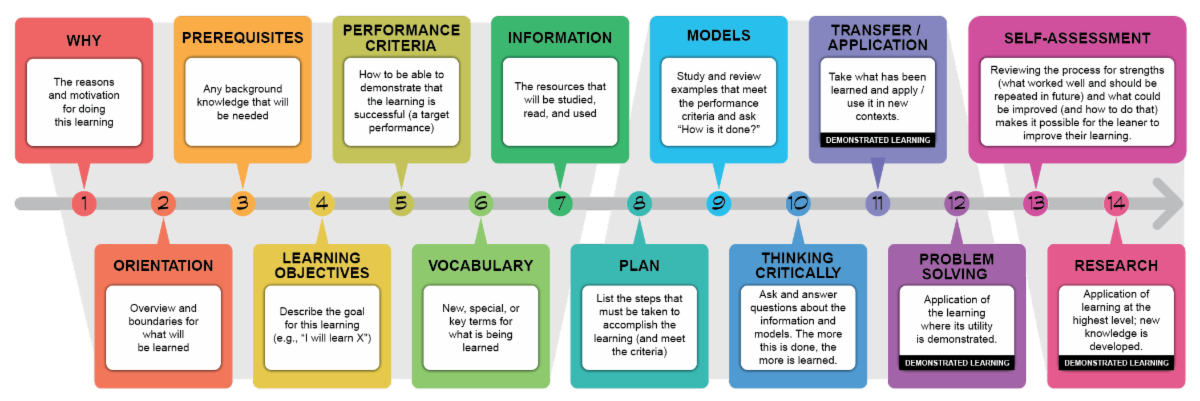
INFORMATION
is the
last step in Stage 1 of the LPM, oriented
towards, bounding, and thinking through
what will be learned. This includes
how to tell if the learning is successful.
This
step is handled very differently by
a learner working on their own and an
educator designing a learning activity.
While the self-directed learner must
seek out the resources they need to
use in order to learn, the activity
designer is responsible for determining
and/or selecting and/or creating that
information.
We tend
to think of information as "stuff" that
gets learned...usually by reading or
listening to a lecture, when it comes
to education. But the astute and creative
designer of learning activities or situations
knows there's a lot more to information
and the knowledge a learner creates
from it.
The schema
we like using is
Forms of Knowledge
(see 2.3.9 Forms of Knowledge and Knowledge
Tables in the
Faculty Guidebook).
In Process
Education, knowledge includes both breadth
and depth, with breadth indicated by
six forms of knowledge:
rules,
concepts,
processes,
tools,
contexts,
and
ways of being.
(Depth is accounted for by levels of
learner knowledge or the levels in Bloom's
Taxonomy.) There is strong evidence
that growth of learning is demonstrated
by a learner being able to represent
their knowledge in a variety of forms.
For this reason, we strongly recommend
that activity designers and educators
challenge learners with information
in a variety of forms, when possible!
The first
step in creating appropriate information
is determining which of the six forms
of knowledge the learner should achieve.
-
Is
it a basic rule that needs to be
memorized?
-
Is
it conceptual knowledge?
-
Is
it knowledge that requires understanding
a process?
-
Is
it knowledge that requires learning
to use a tool?
-
Is
the knowledge unique to a specific
context or multiple contexts?
-
Is
it knowledge that relates to an
individual’s way of being?
There
are learning models or instruments that
are appropriate for each of the respective
forms of knowledge. To illustrate
what an appropriate model might look
like for each form, examples from mathematics
are shown below.
Rule:
memorized fact or set of facts (or convention)
that governs performance in a knowledge
area
-
EXAMPLE: The order of operations
is: PEMDAS (parentheses, exponents,
multiplication, division, addition,
subtraction)
Conceptual knowledge:
an idea that connects a set of relationships;
a generalized idea about something;
the best way to gain conceptual knowledge
is through process-oriented guided-inquiry
learning, POGIL, which makes use of
models
that
students can study or explore.
-
EXAMPLE: multiplication, simplifying,
coordinate system, etc.
Questions
to ask when building a conceptual model:
-
What
are the important components of
the concept?
-
What
needs to be visualized?
-
What
is the prerequisite knowledge upon
which this concept is built?
-
What
knowledge item is similar or related
to the concept being modeled?
-
What
are the boundary issues related
to the concept?
-
What
context is useful for placement
of this concept?
Process knowledge:
a sequence of steps, events, or activities
that results in a change or that produces
something over a period of time. This
is often represented by a
methodology.
-
EXAMPLE:
finding the distance between two
points, (x1,
y1)
and (x2,
y2)
Questions
to ask when building a methodology:
-
Why
are the starting and ending points
significant?
-
Why
is seeing the bigger picture important?
-
When
modeling the process, how do you
define key steps?
-
How
do you improve the design process?
Knowledge in the form of tools:
any device, instrument, or utensil that
serves as a resource to accomplish a
task. This type of knowledge comes in
multiple forms, but a
template or application
is one of the more common forms for
facilitating this knowledge. Note that
a specific perspective or philosophy
can function as a tool if learners are
tasked with explicitly using it.
-
EXAMPLE:
the formula for the area of a triangle:
Area = (1/2)
×
base
×
height
Questions
to ask when building a template or application:
-
What
are the tool’s most important features?
-
What
are the tool’s most important functions?
-
What
is the best simplification for presentation
of the tool to highlight the key
functions and features?
-
What
should be captured in the demonstration
illustrating the tool usage?
Contextual knowledge:
the whole situation, background, or
conditions relevant to the process.
Often this is represented through
case studies or stories.
-
EXAMPLE:
The context for the distance formula
is an application of the Pythagorean
theorem in geometry, such as when
calculating the area of a roof to
be covered in shingles or tiles.
Questions
to ask when building a case studies
or story:
-
What
characteristics make this context
unique?
-
Where
is the critical meaning in the story?
-
What
issues or concerns are addressed
by the story?
-
Where
is it important to analyze and reflect?
-
What
values are being addressed and challenged
and what are their implications?
Knowledge about a way of being:
the set of behaviors, actions, and language
associated with a particular discipline,
knowledge area, or culture. This is
often a
profile
describing
how the individual possessing a given
way of being behaves, what they believe,
and how others perceive them.
-
EXAMPLE:
The mathematician
values
error-free calculation and ensures
it through validating their work.
Questions
to ask when building a profile:
-
What
qualities are associated with that
way of being in a professional in
a given discipline?
-
Should
there be any overlap in the behaviors?
-
How
many behaviors do you put into a
profile?
-
How
do you analyze a quality?
-
What
are the important criteria for a
professional behavior?
-
How
do you represent values within a
professional behavior?
|