|
|
|
REFLECTIONS
Monthly News & Updates
|
|
|
|
This year, we faced not only operational
challenges but also direct attacks from
the current administration on higher
education and on students protesting
for their rights. These assaults on
academic freedom strike at the core
of our mission. Yet, despite this climate,
we sustained operations and advanced
our work—standing firm with students
and educators in defense of education
as a public good.
In this spirit, we appointed Dr. Grady
Batchelor to our board of directors.
He will help us deliver our intellectual
property in new ways, including custom
AI agents that support learning through
Process Education.
We also proudly welcomed a new partner,
Chad Bliss, a disabled U.S. Army veteran,
who has joined us as a commission-only
sales representative. After attending
his first Self-Growth Institute in Santa
Cruz, California, earlier this year,
Chad embraced the program and has since
become a Pacific Crest self-growth mentor.
His passion for service and growth reflects
the values driving our mission.
Our first president, Dan Apple, though
retired, continues to guide Pacific
Crest—training his successor and advancing
our self-growth AI content. His enduring
dedication ensures our founding vision
remains strong as we expand into new
opportunities.
Growth of Pacific Crest
I’m excited to share the progress we’ve
made in the early months of 2025. Our
efforts have been centered on pivotal
initiatives that strengthen both our
growth and operational effectiveness,
underscoring our dedication to building
lasting success. Key areas of focus
for expansion include:
-
Subscription-Based AI Agents
– Expanding our online AI agents
into subscription offerings for
both students and faculty, making
process education easier to access
and integrate into everyday learning.
-
Strengthening the Self Growth Community
– With Chad’s leadership, developing
our network of Self Growth Coaches
to innovate best practices and discover
new ways to apply Self Growth processes.
-
Expanding Our Voice Through Podcast
– As part of our evolution, we are
shifting from a blog to a podcast,
with Denna Hintze transforming our
content into audio using AI tools.
This more accessible format will
expand the reach of our Self Growth
and Process Education communities,
fostering deeper engagement and
greater positive impact.
Looking ahead, we are prioritizing working
to evolve our online learning activities
into a SCORM wrapper. This upgrade will
enable our customers to seamlessly embed
our activities within their own Learning
Management Systems (LMS). By doing so,
we can greatly enhance the user experience,
benefiting both students and commercial
users who are interested in incorporating
our activities into their training programs.
|
|
|
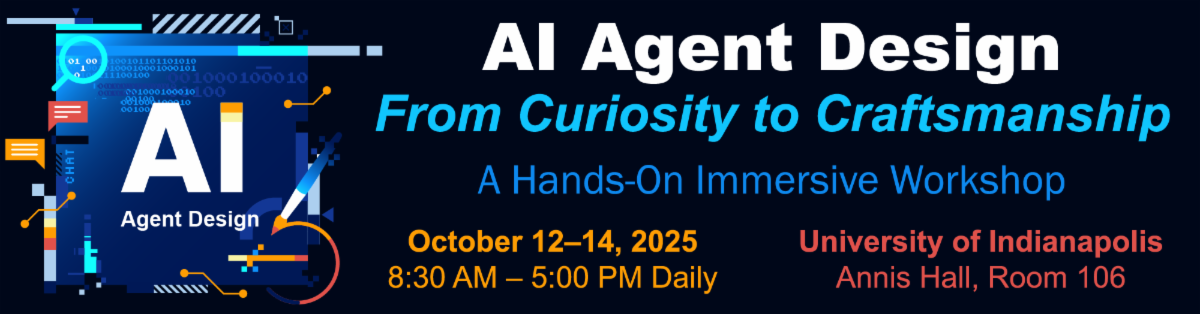
This intensive, practitioner-focused
workshop showcases 10 high-quality,
customized AI Agents developed using
the Pacific Crest Design Process. Attendees
will gain direct insight into what makes
an AI Agent not just functional, but
transformational.
|
|
|
Cost:
$500 per person
Bring 2 from your college, the 3rd attends
free!
|
|
|
Whether you're an educator, developer,
coach, or curious innovator, you’ll
walk away with a clear framework and
hands-on experience for creating AI
Agents that foster self-growth, enhance
decision-making, and elevate performance
in any domain.
Workshop activities
Over the course of the workshop, participants
will:
-
Interact with exemplary AI Agents
in live demos
-
Break down what distinguishes quality
AI Agent design
-
Apply the Pacific Crest Design Process
to craft AI Agents that integrate
methodology, growth capability,
and quality mindset
-
Learn how to align AI Agents with
life, learning, and leadership purposes
Logistics
This on-site Institute consists of 3
intensive days of synchronous participation
(Oct 12 through 14).
Limited Seats Available. Reserve your
spot early.
Take your AI Agent design expertise
to the next level.
|
|
|
As I step into the role of community
organizer for Phase III of the PE Expert
Project, I do so not only as a facilitator
of meetings, but as someone modeling
the very growth this project champions.
My involvement in Phases I and II ignited
a mindset shift: from external benchmarks
to intentional self-cultivation. Now,
in Phase III, I am honored to steward
a shared journey that fosters deeper
presence, mutual support, and high-impact
reflection. A primary goal of the community
is to complement weekly one-on-one meetings
between participants and their self-growth
coaches. As such, I view my organizer
role not only as facilitating biweekly
meetings, but curating a space where
real-time needs are surfaced, seen,
and responded to with authenticity. This
includes a Moodle site that provides
resources as well as exemplars for just-in-time
participant and coach support.
High-quality performance of the community,
both for me and for participants, includes:
-
Broad and inclusive participation
that welcomes diverse voices and
experiences
-
Authentic sharing
in response to evolving community
concerns
-
Meaningful takeaways
that translate into impact beyond
the meeting space
For myself and special guests who join
me for specific sessions, it means embodying:
-
Pre-meeting preparation
grounded in participant needs
-
Inclusive facilitation
that nurtures psychological safety
-
Contextual awareness
of what’s most alive in our shared
space
-
Openness to feedback
and post-meeting reflection to enhance
future gatherings
-
Closing the loop
by converting insights into action
items or community resources
Our gatherings are not intended to be
passive events—they are social performances,
co-created in the moment. The measure
of quality isn’t efficiency; it’s transformation.
As participants, we grow by clarifying
our intentions, sharing from the heart,
and reflecting collectively on what
matters now.
One of the most powerful lessons I learned
in Phase I and II is that tools alone
are not transformative—their power lies
in how we use them to listen to our
lives, collaborate with others, and
reflect with integrity. As such, I envision
some self-growth community sessions
having a hands-on workshop feel where
participants interact with breakout
room leaders to:
-
Use AI-enhanced feedback loops to
elevate reflection and scripting
-
Facilitate Moodle-based knowledge
sharing and modeling
-
Seed mentoring vignettes and cross-pollination
among community members
-
Encourage use of right-sized weekly
practices rooted in our real lives,
not merely as abstractions
I invite each participant in this 26-week
journey to see themselves as more than
an attendee.
You are a co-creator, a mirror, and
a model.
Let’s continue to build a space where
reflection becomes performance, where
scripting becomes becoming, and where
presence becomes legacy. We are
not just working on ourselves—we are
building a shared future.
One breath, one insight, one gathering
at a time.
|
|
Episode 2
Connecting Beyond the Classroom
(FREE!)
|
|
|
Our second
episode focuses on the article
Human-to-Human Relationship Model as
a Strategy for Student (and Teacher)
Success
by Romann-Aas and Hintze, published
in the International Journal of Process
Education, June 2025.
The article
highlights that
true student success stems not just
from techniques, but from authentic
human-to-human relationships.
Inspired by nursing theorist Joyce Travelbee,
it encourages educators to move beyond
"teacher" and "student" roles, instead
seeing each person as a unique individual.
When teachers genuinely connect with
students as whole human beings, fostering
an "I-You" bond, it profoundly impacts
achievement, growth, and willingness
to learn.
The authors
detail a five-phase process for building
these impactful relationships: from
the initial "Original Encounter" where
we move beyond roles, through "Emerging
Identities" where we recognize uniqueness,
to "Empathy" and "Sympathy" (understanding
and desiring to help), culminating in
"Rapport"—a state of experienced relatedness.
This approach aligns perfectly with
Process Education's focus on the "whole
person" and fostering environments ripe
for active learning, where students
feel valued and engaged.
Compelling
evidence shows that strong teacher-student
relationships directly correlate with
not only academic success, but personal
growth…on the part of both teacher and
student! Facilitating this kind of success
isn't about adding more to your plate;
it's about rediscovering the profound
humanity at the core of our educational
journey.
We've finally gotten our ducks in a
row (there were feathers everywhere
and we apologize for that!), making
Listening to Learn
a TRUE podcast, available on Spotify,
Amazon Music, and Apple Podcasts. Simply
choose where you want to hear us!
|
|
Ongoing Series:
The Learning
Process Methodology
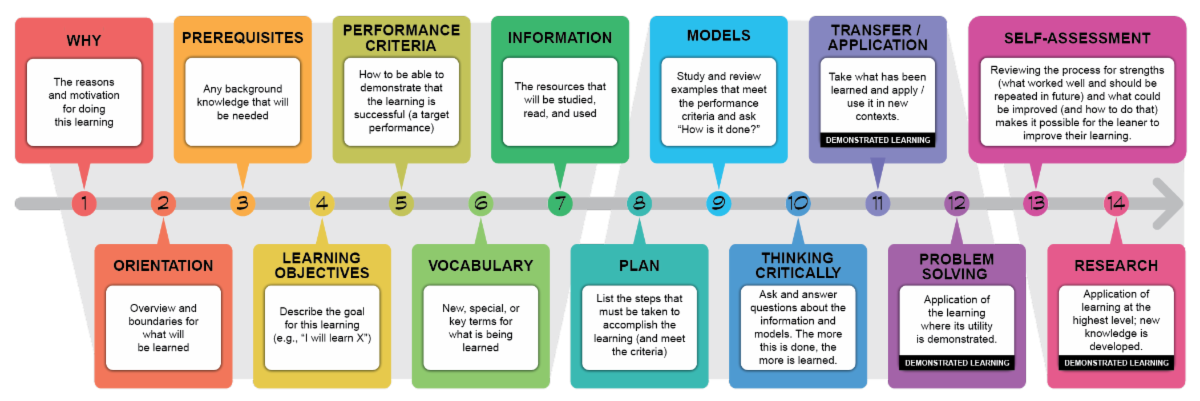
How to Learn in 14 Steps
|
|
|
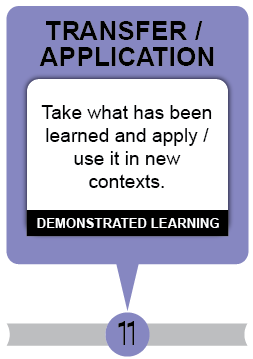
The eleventh step is of the LPM is
Transfer/Application
After Step 10 (Critical Thinking) has
been tackled, the learner is ready to
put their knowledge to work!
|
|
|
|
After thinking critically, the learner
should test their understanding by transferring
it to varying contexts and applying
it in new situations. The underlying
motivation of all adult learners is
the awareness of situations that can
serve as applications of knowledge they’re
learning1.
|
|
This last point is incredibly important,
especially for educators: What use is
knowledge you can’t use? The more we
can put knowledge to use, the more motivated
we are to gain that knowledge. And,
rather ironically, a big part of gaining
knowledge is learning to use it! We
don’t learn to ride a bike by drawing
a picture of a bike, after all…we learned
to ride a bike by riding a bike (even
if it does have training wheels).
According to Nygren in the
Faculty Guidebook
module Elevating Knowledge from Level
1 to Level 3, “testing ideas against
alternative contexts” is how learners
elevate their knowledge from Level 2
(Understanding)
to Level 3 (Application), and then on
to Level 4 (Problem Solving).
In the Transfer/Application step of
the LPM, we’re focused especially on
Level 3:
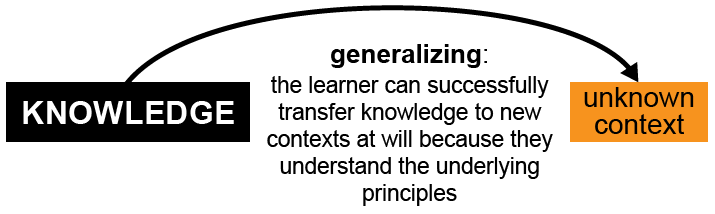
Level 3 Transferring and Generalizing
Apply and transfer a particular item
of knowledge to new situations and contexts.
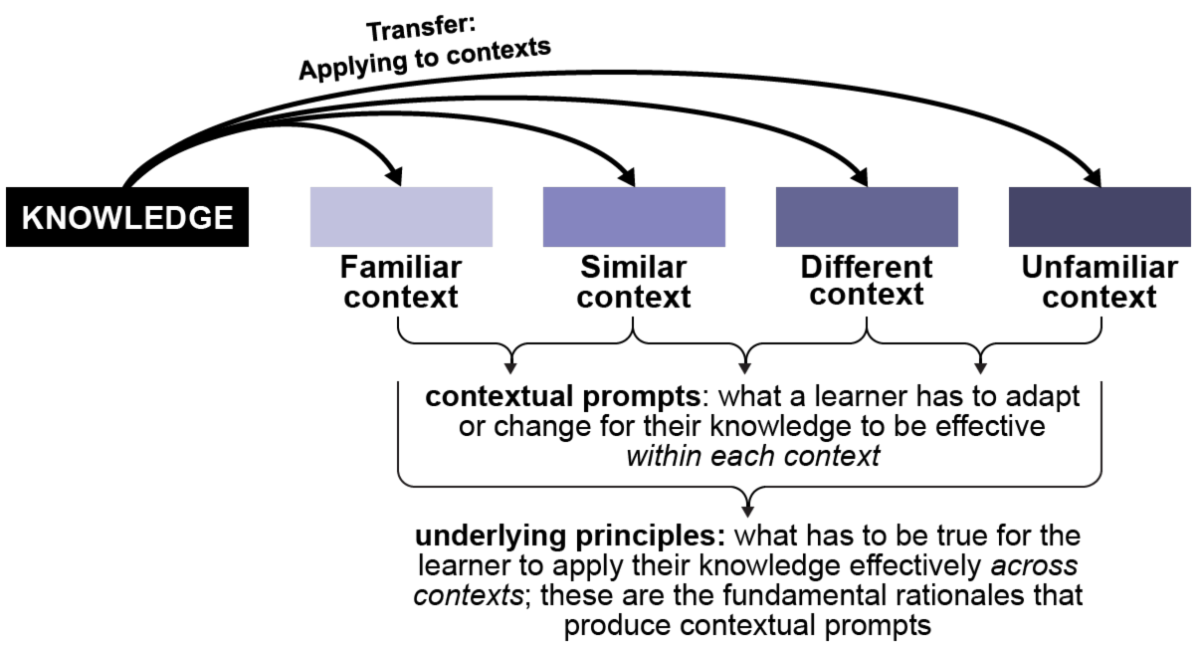
Transferring and Applying knowledge
works like this:
|
|
|
There's quite a bit there to unpack,
but we'll work at it through the rest
of this article! The most important
point is:
Generalizing
knowledge is
not
the same as
transferring
knowledge!
|
|
|
|
The process of generalizing means developing
enough working expertise that knowledge
can be transferred to new contexts
at will.
This is because, in generalizing, you
understand the underlying principles
of a piece of knowledge, rather than
just now to apply it in any given context.
|
|
|
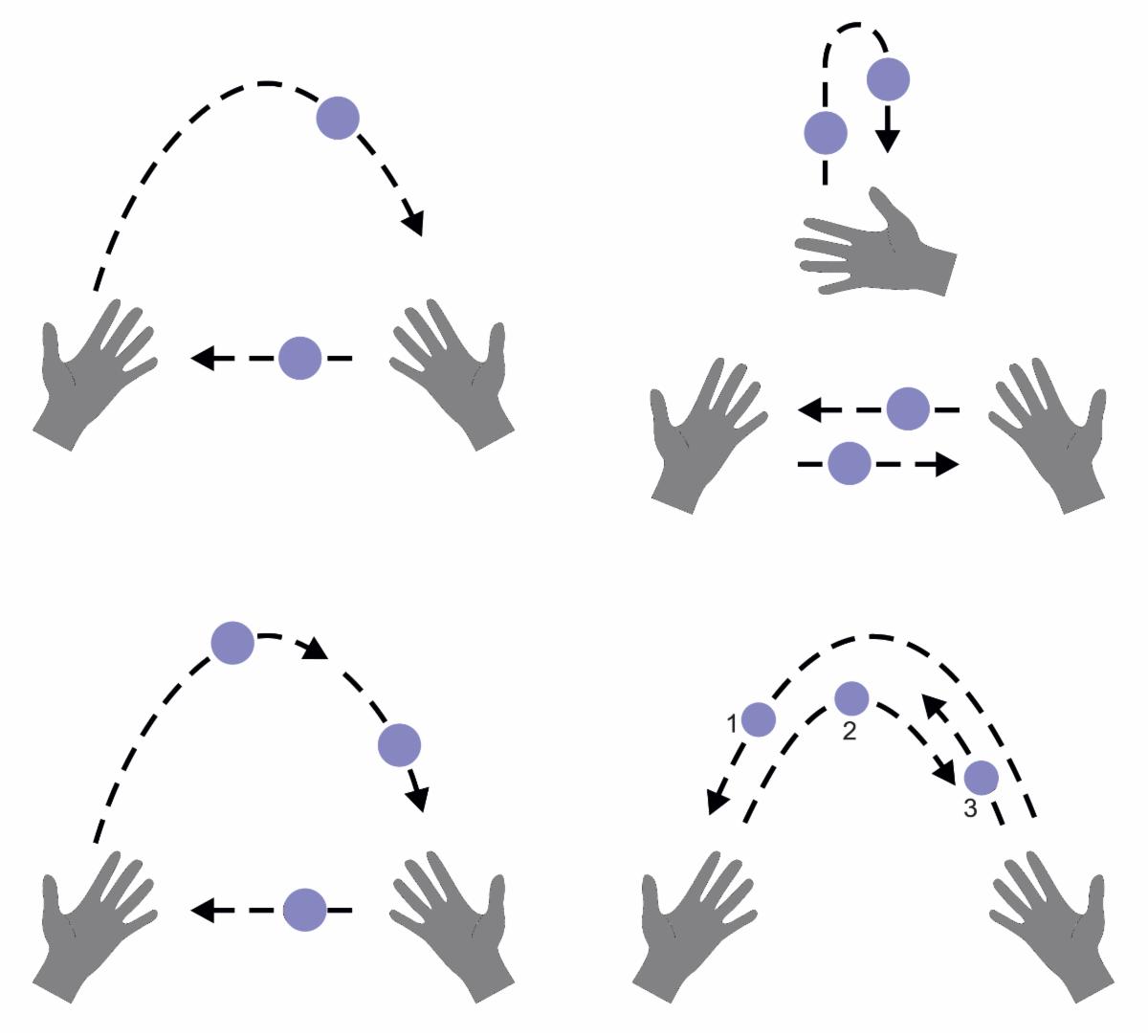
We can state these
underlying principles
somewhat formally:
-
The catch involves reacting smoothly
to the object’s motion and entry
into the hand
-
The throw involves considering the
object’s weight distribution and/or
shape
-
When tossing or catching, you can’t
look at the object in the hand;
you should instead watch the object
in the air
-
Parallel processing is necessary;
we must focus as much on the throw
as the catch When we can perform
the toss and catch, following those
principles, we can successfully
juggle three beanbags!
|
|
We can now look at the
context
for juggling and determine what
contextual prompts
alert us to a situation where we can
apply our new juggling knowledge.
Maybe we see three apples on the kitchen
counter (three similar objects we can
toss and catch). Or what about a dull
moment in a social situation...might
we liven things up by showing off our
new skill? And given the concentration
that juggling requires, maybe we can
juggle our beanbags when we need to
take our mind off something else for
a little while. These are all reasons
(or
prompts)
for juggling (applying
our new knowledge).
We can now look at intentionally applying
our knowledge in
different contexts,
from the familiar to the far.
-
The most
familiar context
is juggling three objects that closely
resemble our trusty beanbags; maybe
tennis balls or balls of tinfoil.
-
The next context is not quite familiar,
only
similar:
three potatoes, or maybe even rocks.
-
Then we can deliberately try a
different context;
maybe we sharpen our juggling skills
by juggling while walking around.
-
The last context in which we can
apply our new skill is also the
least familiar or similar
and the furthest outside our comfort
zone: let’s juggle flaming torches
and chainsaws!
OK...we’re probably not ready for that,
but as we work our way through these
increasingly unfamiliar contexts, we’re
building
working expertise.
Another way to say it is that we are
intentionally
generalizing
the skill of juggling. Once we have
generalized our juggling into even
completely unfamiliar contexts,
we’re become expert jugglers and can
juggle where and how we like without
much trouble: while reciting Shakespeare,
with objects that aren’t all the same,
or while riding a skateboard, for instance.
The point is that when you
generalize
knowledge, you’re engaging in a deliberate
process of learning to
elevate the level of your knowledge.
When you
transfer
knowledge, you’re
applying it in new contexts or circumstances.
|
|
When designing learning activities,
structure is crucial and skill exercises
(opportunities for learners to apply
their knowledge to contexts) should
be carefully scaled in difficulty. Exercises
should start with a familiar context,
then move into less familiar and finally
unfamiliar contexts in at least three
exercises of increasing difficulty.
This grows learner confidence and is
what
leads
to generalization.
With this in mind, skill exercises should
be:
-
Sufficient in number
-
Contextually relevant
-
Demonstrate differing levels of
complexity
-
Give clear evidence of progression
in contexts (most to least familiar)
-
Work toward generalization
|
|
Once a learner can
generalize
their knowledge, they’re ready for the
next step of the Learning Process Methodology:
Problem Solving.
(See
you next month!)
|
|
- Knowles, M., Holton, E. F., &
Swanson, R. A. (2005).
The adult learner: The definitive
classic in adult education and human
resource development (6th
ed.). Burlington, MA: Elsevier.
|
|
Self-Growth Tip:
Getting Out of Our Own Way
|
|
|
When
we face obstacles to our professional
and personal growth, it's easy to blame
external factors. But what if the greatest
barrier to your progress isn't a lack
of resources, time, or support, but
is actually you?
|
|
|
|
The sayings
we use—"I overthought it," "I made a
mountain out of a molehill," or "I sabotaged
that opportunity"—are telling. They
reveal a deeper truth: we are often
the architects of our own obstacles.
While external challenges are real,
internal impediments, like self-doubt,
overthinking, or a fear of failure,
can be far more limiting.
Instead
of asking, "What's in my way?" a more
empowering question is, "How did I contribute
to this obstacle?"
When
you discover you are the source of your
own roadblock, the next step isn't to
assign blame but to focus on releasing
that self-imposed limitation. True self-growth
begins with self-awareness, and by taking
responsibility for your part in the
problem, you can start creating meaningful,
lasting solutions.
What's one small internal obstacle you
can work on removing this week?
|
|
|
From August 4-8, Pacific Crest held
its latest 5-day Self-Growth Institute
(SGI) at the University of Indianapolis. The
event drew together 15 dedicated participants,
four of which had attended a previous
SGI and who assumed various coaching/mentoring
roles. New to this event were a
variety of personal growth GPTs that
helped individuals craft long-term growth
goals within a life vision portfolio. This
innovative element harvested reflective
writing prompts that were conducted
between the standard set of cooperative
learning/growth activities in Annis
Hall and which were explored on a self-paced
basis during informal evening sessions. Each
participant thoughtfully entered and
interacted with their own life story
and life aspirations. With the
help of the GPTs, personal reflective
writing was better leveraged and integrated
than in the past. Each participant
left the event with a clearer picture
of their
Horizon Self—
an evolving, actionable vision of who
they are becoming that breathes holistic
purpose into annual measures of success
and weekly growth opportunities.
Here
is a sampling of discoveries from the
week.
Falling down the Rabbit Hole
Laura described the opening day as “falling
straight into Wonderland.” From the
first handshake to the first GPT-powered
exercise, participants were asked to
think metacognitively before catching
their breath. The
night work—journaling
with AI prompts about the Horizon Self—set
the tone: growth here would not end
when the day did.
Shifting the Compass
For Natalie, the week began under the
weight of inhibition, but she planted
a flag:
this would be a week for growth.
She practiced redirecting her language
from fixed to growth-oriented, a steady
correction like adjusting a boat’s tiller.
By midweek, she shifted from being a
judge of herself to being a witness,
“watching the clouds” of thought drift
by without condemnation.
Quiet Victories
Josh shared how he discovered the power
of
reflection-in-action—
adjusting course during a task, not
just after. Daily rehearsal of upcoming
conversations, small wins in focus,
and nightly journaling revealed that
growth is not accidental. It can be
planned, tracked, and shared with others.
Technology, Teams, and Trust
Christine found herself thriving in
the “Manage” role within rotating teams,
balancing coordination with creativity.
AI tools became an ally, helping participants
design life plans, craft quality-of-life
indices, and envision new possibilities.
Just as powerful were the late-night
conversations where trust and curiosity
deepened connection with other participants.
Anchors and Lifelines
Peter entered with doubts “like an overstuffed
backpack.” A simple mantra from the
Truth-Seeker GPT—I
belong because I care—
became his life preserver. Struggles
with technology and uneven results reminded
him that growth isn’t always smooth,
but he left with powerful first real
strokes toward the deep end.
Mirrors and Firelight
For Abigail, the Institute held up a
mirror, revealing how she had been pouring
into others without checking her own
needs. Her Horizon Self now includes
self-care as priority. Meanwhile, Hiba
tended her fire with five growth goals,
practicing the SII model (Strengths,
Improvements, Insights) to mentor others
and discovering coaching as “showing
people how to build their own fire.”
Blueprints and Beams
James likened the experience to engineering.
Legacy became not abstract but structural:
family, community, and volunteer work
became beams and foundations. From this
emerged his
26-week challenge
that is being carried in the 2025 Self-Growth
Community, turning ideas into stepwise
actions. His mantra was “Growth never
retires.”
Clarity and Confidence
For Aidan, the first four days brought
a shift from fog to forward momentum. The
event recognized and celebrated personal
talents, harnessed GPTs as creative
partners, and provided an environment
for practicing self-monitoring without
judgment. His arc moved from doubt to
directed energy.
Becoming the Architect
Julianna closed the week seeing herself
not just as a learner but as a
life architect.
She integrated the Weekly Transition
system—reflection, planning, scripting,
and monitoring—into her personal toolkit,
alongside a set of tested mentoring
skills and a solidified QoL framework.
|
|
Windows of Growth
Across these stories and associated
event happenings, a dozen transformative
experiences stand out:
-
Reframing language within a growth
mindset.
-
Reflecting-in-ac2tion during performances.
-
Investing in trust-building conversations.
-
Discovering personal self-care needs.
-
Taking some restorative pauses.
-
Using AI to streamline growth planning.
-
Wrestling with technology as growth.
-
Engaging in real-time self-monitoring
-
Practicing SII coaching.
-
Seeing personal legacy as a life
blueprint.
-
Internalizing a Weekly Transition
system.
-
Celebrating belonging to a self-growth
community.
Looking Forward
The week was not tidy, nor was it meant
to be. It was kaleidoscopic, demanding,
and clarifying. Participant experiences
demonstrated that the Horizon Self is
not waiting at a distant finish line.
It is an evolving creation, informed
by and slowly modified by daily choices,
reflections, and the courage to step
into both chaos and clarity. If
you have not been to an SGI, stay tuned
for announcement of the next event in
2026 and then circle the dates for consideration
on your calendar. It promises to
be an investment in yourself with a
lifetime of dividends.
|
|
|
Keeping an Eye on Higher Education in
Troubling Times
|
|
|
|
What is happening around us is not only
impacting institutions of learning but
the
human beings
who gather there to teach and learn.
Below are various sources of information
and resources that may prove helpful.
Do what you can to inform and protect
yourselves and those around you. Please
also remember the words of
Timothy Snyder,
historian of Central and Eastern Europe,
the Soviet Union, and the Holocaust:
“Do
not obey in advance.
Most of the power of authoritarianism
is freely given. In times like these,
individuals think ahead about what a
more repressive government will want,
and then offer themselves without being
asked. A citizen who adapts in this
way is teaching power what it can do.”
|
|
| | |