|
|
|
REFLECTIONS
Monthly News & Updates
| |
| |
|
This month's columns include:
- Series: The Learning Process Methodology
- Step 3: Prerequisites
- Something to Think About: We Shape Each Other's World
- Monthly Self-Growth Tip: Getting Past Harsh Self-Judgment
- Contextualizing Learning Skills: Identifying Key Ideas
- Unmet Needs and Effective Learning
|
|
Ongoing Series:
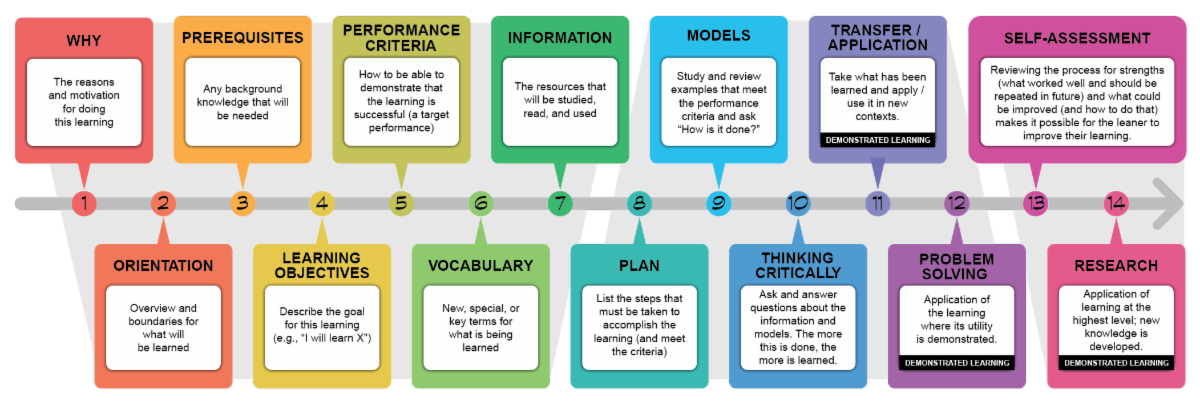
The Learning Process Methodology How to Learn in 14 Steps
| |
|
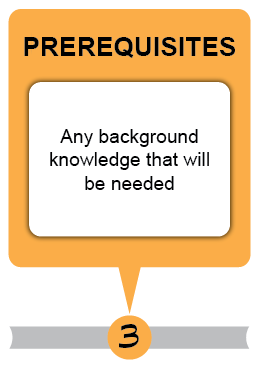
The third step is of the LPM is PREREQUISITES
This
is the prior knowledge or skills that are necessary as background or
foundation for new learning about this topic. If you’re the one applying
the LPM to a topic in order to learn something, review your identified
prerequisites again after setting a specific learning objective (Step
4). If you’re creating a learning activity, it’s important to remember
that students and others who may use your activity need to know what
prior knowledge and skills they need to complete the activity, including
any reading assignments that should be completed in advance.
| |
|
|
We
know from the research that has been done on brain-based learning that
when references can be made to what is already known, the brain
automatically utilizes those dendrites and synapses that have already
been created. By making such connections for learners, we are actually
facilitating brain growth as well as learning.
In The Learning Process Methodology: A Universal Model of the Learning Process and Activity Design, educator and author Matthew Watts explains the importance of this step:
Prerequisites
identify the transferable knowledge needed to perform strongly in the
learning experience. The paradigm of learning as a “successive
transition between knowledge states” is well known from classic
cognitive research (Dochy, 1995). The hierarchical nature of knowledge
within a content area is well supported, e.g., in Mathematics the
learning of higher-level rules is dependent on the mastery of
lower-level rules (Gagne, 1970). By
incorporating a component that asks the question “What do you already
know?” a learning activity takes advantage of knowledge from prior
courses or life experiences and relates it to the new learning. These
questions that draw on previous knowledge and the discovery activity
prepare the learner for the reading and models that follow. This
component goes with Merrill’s second principle of instruction –
Activation, and Gagne’s third event of instruction – stimulate the
recall of prior learning. Ultimately, the richest resource for adult
learners may be the relating and interpreting of personal experiences
(Lindeman, 1926).
-
Dochy, F., & Alexander, P. (1995). Mapping prior knowledge: A framework for discussion among researchers. European Journal of Psychology of Education, 10(3), 225-242
-
Gagne, Robert M. (1970). The conditions of learning. New York, NY: Holt, Rinehart and Winston.
-
Lindeman, E. (1926). The meaning of adult education. New York, NY: New Republic, Inc.
As
Watts notes (see highlighting), there are different ways to share or
even check prerequisite knowledge and skills. Following are examples
from Pacific Crest curricula:
|
|
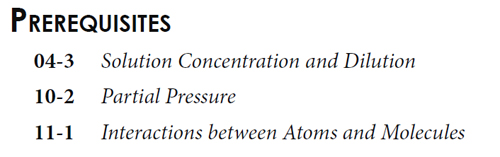
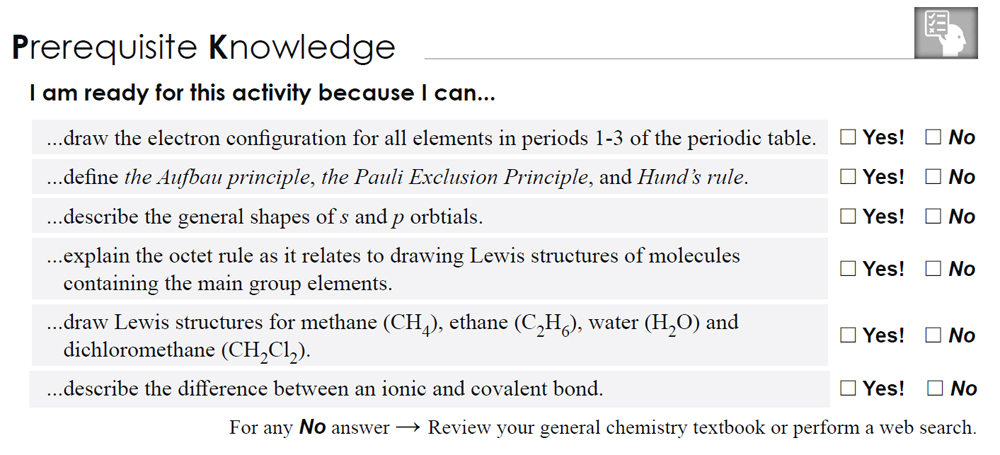
Foundations of Chemistry provides a listing of which activities the student must be able to successfully complete prior to the current one. | |
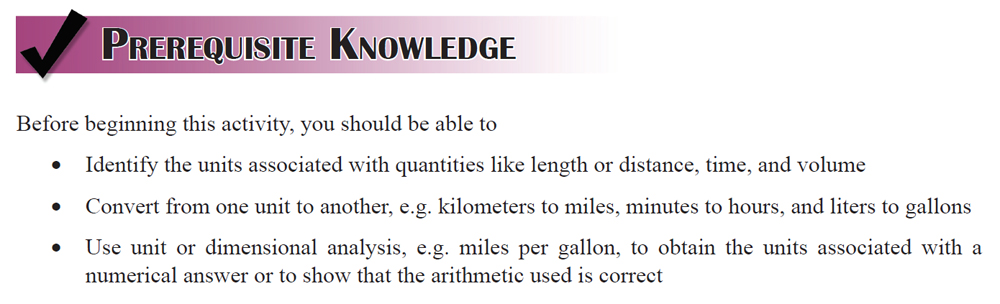
Solving Real Problems with Chemistry offers a list of the performances the student should have already mastered before starting the current activity. | |
Foundations of Organic Chemistry lists the performances the student should have already mastered, but with YES/NO options and what to do in case of a NO answer. | |
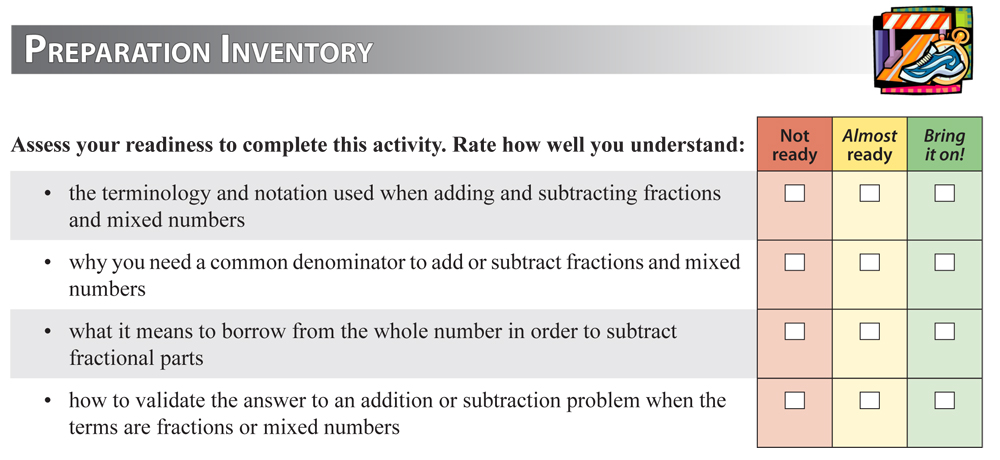
Foundations of Mathematics Activity Book offers a preparation
inventory with three options; the intention is for the instructor to
review student responses before continuing with the activity. | |
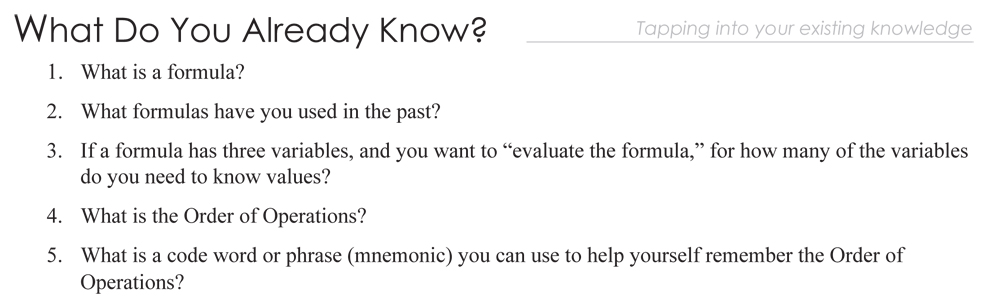
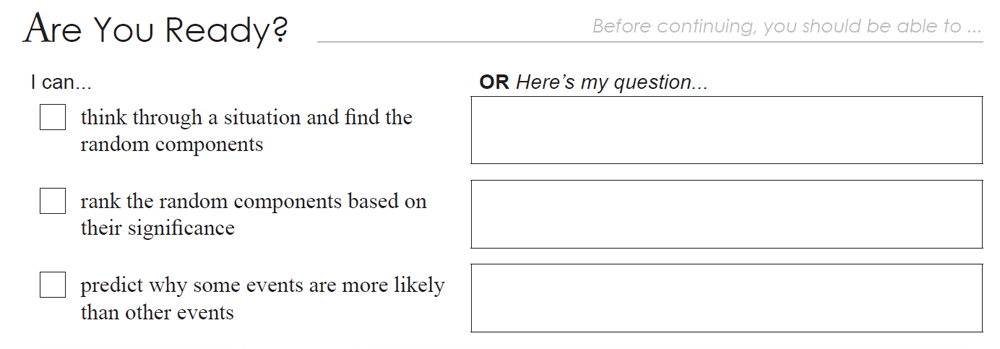
Quantitative Reasoning and Problem Solving offers two different sections, both of which depend on prerequisites: What Do You Already Know? lists questions the student should be able to answer before starting the current activity and Are You Ready?
is a listing of performances the student should have mastered with
check boxes with a “OR here’s my question” alternative in case the
student doubts the security of their mastery of prerequisites. | |
Something to Think About... | | |
|
|
Our
life is so constituted that it cannot be lived except as one person
lays him or herself open to another person and puts him or herself into
that person’s hands either by showing or claiming trust. By our very
attitude to another we help to shape that person’s world. By our
attitude to the other person we help to determine the scope and hue of
his or her world; we make it large or small, bright or drab, rich or
dull, threatening or secure. We help to shape his or her world not by
theories and views but by our very attitude towards him or her.
— Knud Løgstrup The Ethical Demand
| |
|
Monthly Self-Growth Tip:
Getting Past Harsh Self-Judgment
| | |
|
|
To deal effectively with this impediment to living a quality life and continuing to grow, there are 3 skills we need to hone and a strategy we need to put in place:
-
LEARNING SKILL Controlling judgmental self-talk: confronting and changing negative inner messages
-
GROWTH SKILL Valuing growth: appreciating opportunities for increasing your capacity
| |
-
MENTORING SKILL Being non-judgmental: withholding or avoiding using one’s personal standards or opinions
-
STRATEGY Develop
self-assessment performance expertise. Do this by first identifying
instances of self-judgment and intentionally replacing it with
self-assessment. Then assess your self-assessments as if they were the work of someone else who you deeply care about
A further word on that strategy:
Most people find it more difficult to self-assess than to assess someone else.
You might expect
that because you know yourself better than anyone else does, you’d be
the best person to assess yourself. But performing an assessment
requires some degree of objectivity—you must be able to see the
performance as a thing that stands separate from your feelings about
your performance. That’s not easy but the ability to remain objective
while performing an assessment is one hallmark of a strong assessor.
Here’s an example to help clarify things:
Suppose you are
asked to look at a photograph of a landscape, and then let the
photographer know the strengths of the picture and what the photographer
could do to improve the next photo (areas for improvement). What would
you look at? On a basic technical level, you might notice if the picture
is in focus or if the photographer’s thumb is covering part of the
picture. Now suppose the photo is of you! The basic tendency when
looking at the second photo is to focus upon yourself and how YOU look.
It is a challenge to keep what you think and feel about how you look in
the photo out of your assessment of the photo itself—in other words, to
remain objective. It is difficult work but some of the most rewarding
you can do when it comes to continuing your own improvement and growth!
| |
Identifying key ideas: determining the important components of a message
| | |
|
During
reading time, read a page or paragraph and ask what was important. Tell
a story about something that happened in your day and offer your ideas
on what was important. Then ask them what seemed important to them
(honoring different perspectives!). | |
|
It’s important to
use restating or rephrasing to show that you can focus on what is
important when they communicate (modeling). Ask them to do the same!
| | |
|
Asking
“What matters here and to who?” is critical. Depending on the kind of
message (literature, historical record, poetry, biography, photo,
painting, etc.), the audience(s) and author may have different
priorities. Being able to appreciate what mattered to an author versus
what might matter to a reader or viewer is an important aspect of this
skill. | |
|
Having students
learn to analyze different types of messages (and to appreciate that
messages can be found in various media) helps with this skill.
| | |
|
The
first thing that comes to mind for many of us is word problems! And
yes, that’s central here. Whether we’re talking about a simple
mathematical “two trains leave their respective stations” problem or an
advanced engineering modeling problem, being able to isolate messages
and then determine which components are important is a critical skill. | |
|
As in the arts,
exposing learners to messages in a variety of forms will help hone this
skill, as they will appreciate the idea of a message that transcends any
single form or problem. When that skill is in place, having students
create problems for others and then solve them can strengthen the
ability to identify important information in a message (problem).
| | |
|
While
watching a film or show, pause from time to time, especially after a
character speaks for an extended period, and let everyone say what they
found the important parts to be. This can be done with a “Tell us about
your day” sharing period too, where each family member gets a few
minutes to tell about their day. | |
|
Then the others get
to say what they found important about the day. The differences in
perspective should be honored and appreciated…and will likely lead to
some laughter, especially if family member ages and interests are very
different.
| |
Unmet Needs and Effective Learning | |
|
All Maslow quotes are from A Theory of Human Motivation, by A. H. Maslow (1943), published in Psychological Review, 50, 370-396.
http://psychclassics.yorku.ca/Maslow/motivation.htm
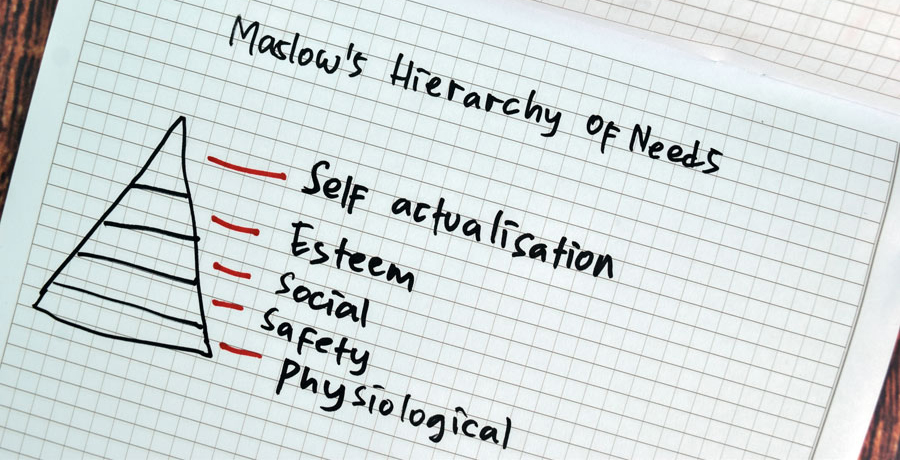
Maslow’s Heirarchy describes five levels of needs,
the first/lowest four termed “deficiency needs”. Maslow described these
as needs, that when unmet, result in negative repercussions, either
physiologically or psychologically. These levels of deficiency needs
are, from lowest to highest,
-
Physiological (air, food, water, sleep, etc.)
-
Safety (security, health, resources, employment, etc.)
-
Love/belonging (friendship, family, etc.)
-
Esteem (self-esteem, confidence, respect of and by others)
Higher level needs only come into play and receive focus when the levels below them are met. Maslow explains:
| |
These
basic goals are related to each other, being arranged in a hierarchy of
prepotency. This means that the most prepotent goal will monopolize
consciousness and will tend of itself to organize the recruitment of the
various capacities of the organism. The less prepotent needs are
minimized, even forgotten or denied. But when a need is fairly well
satisfied, the next prepotent (‘higher’) need emerges, in turn to
dominate the conscious life and to serve as the center of organization
of behavior, since gratified needs are not active motivators.
One implication on which we’d like to focus is
that realization of the highest level (Self-Actualization) in any
sustained and focused way (as a primary goal or motivator) requires that
each of the deficiency needs are met first.
In Maslow’s own words:
It (the
term self-actualization) refers to the desire for self-fulfillment,
namely, to the tendency for him to become actualized in what he is
potentially. This tendency might be phrased as the desire to become more
and more what one is, to become everything that one is capable of
becoming.
The
specific form that these needs will take will of course vary greatly
from person to person. In one individual it may take the form of the
desire to be an ideal mother, in another it may be expressed
athletically, and in still another it may be expressed in painting
pictures or in inventions. It is not necessarily a creative urge
although in people who have any capacities for creation it will take
this form.
The
clear emergence of these needs rests upon prior satisfaction of the
physiological, safety, love and esteem needs. We shall call people who
are satisfied in these needs, basically satisfied people, and it is from
these that we may expect the fullest (and healthiest) creativeness.
Since, in our society, basically satisfied people are the exception, we
do not know much about self-actualization, either experimentally or
clinically. It remains a challenging problem for research.
Assuming then that the vast majority of students
are not basically satisfied people, to what degree must educators focus
on helping them meet their deficiency needs before meaningful learning
can take place? At one end of the spectrum (or level of need) is the
case of young homeless children. That is very clear-cut example of
deficiency needs not being met and the subsequent impact this can have
on learning. These young students must have food, shelter, and some
degree of safety before they can even begin to focus on learning things
like reading or math. (It is nice to note that more school districts are
beginning to find ways to meet those needs so that students in this
unfortunate situation are still able to learn. There are many resources
available on this topic; http://www.serve.org/nche/ is one such site.)
But what of college-level students? At one time,
college was seen as part of the pursuit of self-actualization…it was not
necessary to obtain a college degree to “live the good life.” But
things have changed in such a way that attaining a college degree is now
seen as a basic prerequisite for the majority of jobs that pay more
than minimum wage. More concerning, something as basic as life expectancy is positively affected by having a college degree.
As such, attending college is not the luxury it once was and may
actually qualify, in many cases, as an attempt to meet needs at the
level of Physiological and Safety.
If this is the case, we have to wonder: To what
degree do deficiency needs at the level of Security, Belonging, or
Esteem affect or even make impossible meaningful teaching within our
classrooms? We think this likely enough that we’d like to put forward
the notion that the Classification of Learning Skills,
especially the Social and Affective Domains, might well hold the key
for helping students meet their deficiency needs even as opportunities
for some degree of self-actualization are realized. Not only will
helping students build learning skills such as Persisting (continuing on
a reasonable path despite low mood or mounting difficulties), Adapting
(changing direction when feedback to do so is reasonable and trusted),
and Seeking help (accepting that you need outside assistance and asking
for it) literally help them be more effective learners; helping students
build those skills will help them do what they can to meet their
deficiency needs.
| | | | |