|
|
|
REFLECTIONS
Monthly News & Updates
|
|
|
|
Episode 6
The 6 "Levers" for Improving Performance
|
|
|
This
deep dive into the
Theory of Performance
provides a comprehensive breakdown of
how worthy accomplishments are produced
through high-level performance in various
learning contexts. The analysis is built
upon the integrated Performance Model,
which posits that performance—defined
as integrating skills and knowledge
to produce a valuable result—is the
product of six interconnected components:
identity, skills, knowledge, context,
personal factors, and fixed factors.
Importantly, performers control five
of these areas, allowing for continuous
development and growth. The sources
detail that making substantial improvements
to performance requires recognizing
that these components co-exist and cannot
be separated. Optimal performance is
achieved by adhering to three axioms:
engaging the Performer’s Mindset (an
optimal emotional state), promoting
Immersion (an enriching environment),
and fostering Reflective Practice. By
advancing their level of performance
through this intentional approach, organizations
and individuals realize tangible outcomes,
including increases in quality, capability,
capacity, skills, and identity, alongside
a decrease in the cost and effort required
to achieve results.
|
|
Based on 1.2.1 Theory of Performance
by Don Elger in the
Faculty Guidebook).
Created with the help of Notebook LM.
|
|
|
Even
if self-growth isn’t your current focus,
the questions and reflections in this
article are likely to offer a perspective,
insight, or quiet reminder you’ll find
useful in your own life.
On December 3rd
the Self-Growth Community opened space
for the uncomfortable, the unresolved,
and the outright frustrating aspects
of personal development. Participants
were invited to bring their burning
questions, inner contradictions, or
quiet disagreements with self-growth
culture into the open.
A rotating panel of three experienced
self-growth coaches in each session
responded to live prompts and participant
challenges, offering insight, alternatives,
and validation—not prescriptions. Similar
questions were paired, and the coaches’
responses were refined into a shared
tone of voice using suggestions from
the Coach GPT. Paired questions were
sequenced using five categories that
follow the natural arc of a self-growth
journey.
|
|
|
Orientation & Safety
These
questions normalize why self-growth
can feel overwhelming or emotionally
heavy, reframing discomfort as a sign
of honesty rather than failure.
|
|
|
Why does self-growth feel like just
another thing on my plate, competing
with everything else?
Self-
growth often feels heavy when it’s treated
as an addition rather than an integrator.
When practices become extra tasks, they
compete with work, family, and rest
instead of clarifying what truly matters.
That friction signals a drift from purpose
toward process. At its best, self-growth
simplifies—helping release misaligned
commitments and act with intention instead
of reaction. If growth is increasing
pressure, the question may not be how
to do more, but how the process could
better support the life you’re already
living.
Is it normal for self-growth to feel
uncomfortable or emotionally heavier,
especially when I’m doing it “right”?
Yes.
Emotional heaviness often means self-growth
is touching something real. As awareness
deepens, misalignment, fatigue, or unresolved
tensions may become harder to ignore.
That discomfort doesn’t signal failure—it
signals clarity. Growth often removes
protective numbing before new strength
is built. The work isn’t to rush past
the feeling, but to stay present and
honest. Self-growth isn’t meant to feel
good all the time; it’s meant to support
truth, agency, and alignment over time.
|
|
|
Design & Readiness
These
questions explore how thoughtful design
supports follow-through, and how resistance
can signal readiness rather than a flawed
plan.
|
|
|
What typically derails a weekly self-growth
transition—and how can I design my week
so intentions turn into action?
Weekly transitions often fail due to
under-design, not lack of motivation.
Intentions that are vague or disconnected
from lived experience rarely guide action
when life gets busy. Effective design
starts with reflection—what actually
happened, where energy dropped, and
where progress felt real. From there,
intentions need to be concrete and humane.
Designing for specific moments and anticipating
obstacles turns insight into small,
realistic commitments rather than abstract
goals.
What does it mean if I still resist
journaling or reflection, even when
my plan is well designed?
Resistance doesn’t necessarily mean
the plan is wrong. Reflection can surface
emotions or truths that require more
inner strength than is currently available.
Sometimes resistance signals overload,
mis-timing, or that a tool no longer
fits. Rather than forcing compliance,
curiosity helps:
What feels heavy? What am I protecting?
Growth practices should serve readiness,
not override it.
|
|
|
Principles vs. Practices
These
questions separate enduring self-growth
principles from adaptable practices,
easing anxiety about “doing it right.”
|
|
|
Is it necessary to use every step in
the self-growth methodology?
No. Methodologies
are supports, not requirements. Each
step serves a function—reflection, intention,
learning—but value lies in fulfilling
those functions, not rigidly following
a sequence. Using every step can help
when learning a system, but over time,
discernment matters more than completeness.
Are there non-negotiable elements of
self-growth—or is it acceptable to adapt
practices over time?
There
are few non-negotiable practices, but
there are non-negotiable principles.
Growth requires (i) willingness to reflect,
(ii) choosing intentionally, and (iii)
learning from experience—but how you
do that can evolve. Adapting practices
isn’t a lack of commitment; it’s often
a sign of maturity.
|
|
|
Ownership & Identity
These
questions help reclaim self-growth as
an internally referenced journey, not
a response to expectation or comparison.
|
|
|
How can I distinguish between authentic
intentions and externally driven goals?
Internal
resistance is a useful signal. Intentions
aligned with who you want to become
tend to feel meaningful even when difficult,
while externally driven goals often
feel draining or performative. Shifting
from what you’re doing to how you want
to show up restores choice and grounds
growth in identity rather than obligation.
How do I stay engaged in self-growth
without turning it into pressure or
comparison?
Pressure
arises when growth becomes socially
measured instead of internally referenced.
Much growth is invisible and nonlinear.
If self-growth feels evaluative, it’s
worth asking who you’re performing for.
Re-centering on your own values restores
growth as a personal relationship, not
a ranking system.
|
|
|
Integration & Sustainability
These
questions focus on closing a growth
cycle with both ambition and permission.
|
|
|
How can I design an annual transition
that raises expectations while honoring
what actually happened?
Effective
annual transitions begin by clearly
marking the end of a cycle. Honoring
effort, learning, and gaps creates a
grounded foundation. Expectations should
be high enough to require growth across
multiple areas of life—otherwise, the
bar is likely too low.
After surfacing resistance and doubt,
what’s worth carrying forward—and what
can I let go?
Integration asks for selectivity, not
completeness. Often, it’s one insight
that felt true or one intention that
still feels alive. Letting go doesn’t
mean abandoning growth—it means releasing
pressure to resolve everything at once.
The goal isn’t answers, but a trustworthy
relationship with your own growth.
|
|
Self-Growth
Tip:
Surviving the Holiday Crunch: The Power
of Your "Ideal Self"
|
|
|
|
|
As the semester wraps up and the holidays
begin, educators often face a perfect
storm of demands: final grading, grant
or grade deadlines, and departmental
obligations, all of which collide with
family gatherings and holiday prep.
|
|
It is easy for your to-do list to become
a source of guilt rather than a tool
for productivity, but we'd like to share
a strategy to reclaim your time this
season:
Filter your obligations through your
"Ideal Self," not your "Ought Self."
This isn’t just “Say NO” more often
but something much more useful!
The Concept
-
Your "Ought
Self"
adds items to your list based on
guilt, external pressure, and the
feeling that you should do something
to please others.
-
Your "Ideal
Self"
is rooted in your personal values,
your long-term goals, and the person
you actually want to be (e.g., a
rested parent, a focused researcher,
a present partner).
When you strengthen your connection
to your Ideal Self, you can
establish broad criteria
(personal
rules) that make saying "no" easier
and less emotionally distressing.
How to Apply This Idea
(Holiday & End-of-Semester Examples)
Instead of agonizing over every request,
measure it against the criteria of your
Ideal Self.
1. The Department Holiday Gathering
-
The Ought Self (Guilt):
"I
should
go because the Chair is hosting
it and I don’t want to look uncommitted
to the department culture."
-
The Ideal Self (Values):
"I value restoration and quality
time with my children during this
break."
-
The Criteria:
During the break, I only attend
work events if they are mandatory
or genuinely bring me joy.
-
The Result:
You politely decline the invitation
to spend the evening at home.
2. The "Urgent" Student Email
-
The Ought Self (Guilt):
"I
should
reply to this student's question
about next semester's syllabus on
December 26th so I look responsive
and helpful."
-
The Ideal Self (Values):
"I aspire to be an educator who
models healthy work-life boundaries."
-
The Criteria:
I do not open my inbox between December
24th and January 2nd.
-
The Result:
You set an automated Out-of-Office
reply and don't feel guilty about
the delay.
3. The Extra Committee Request
-
The Ought Self (Guilt):
"I
should
join this ad-hoc holiday planning
committee because my colleague asked
me personally."
-
The Ideal Self (Values):
"I need to protect my mental energy
to finish my manuscript in January."
-
The Criteria:
I am saying no to all new service
commitments until the Spring semester
begins.
-
The Result:
You say no immediately, knowing
it protects your research goals.
The Takeaway:
The stronger
your vision of your Ideal Self becomes,
the less power guilt has over your schedule.
Use that vision to cross items off your
list before you even start them.
|
|
|
What do you know about
LEARNING SKILLS?
|
|
(The complete listing is available at
http://www.processeducation.org/cls/web/)
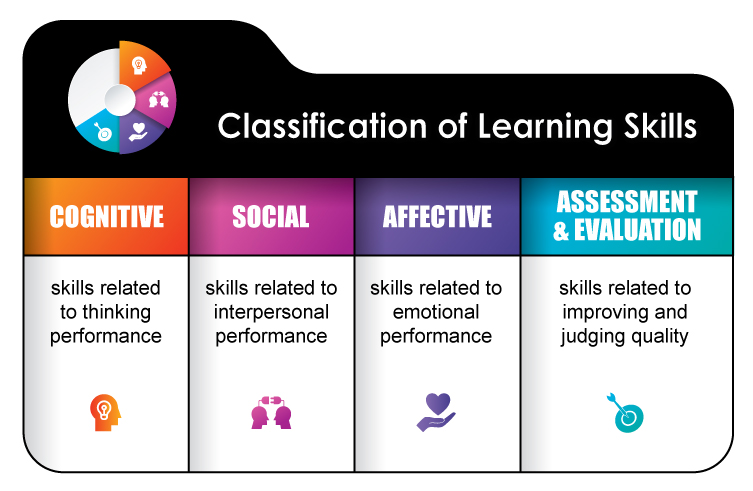
Learning
skills are aptitudes, abilities,
and behaviors related to increasing
quality of learning performance. Learning
skills are distinct from disciplinary
content and universal because they apply
across
all
contexts of performance. They are sorted
into four categories: Cognitive, Social,
Affective, and Assessment & Evaluation
(see the graphic below).
|
|
|
When
we improve our learning skills, the
quality of our learning performance
increases, thus increasing our self-efficacy,
which is the positive expectation that
we can add new performance capabilities,
enhance the efficiency and effectiveness
of performances, and use insights from
assessment to raise the quality of performances
in ways consistent with our goals.
Not bad, eh?
For educators
at ANY level, this means that
when
you target specific learning skills
in your classes, you help your students
become better learners and have greater
appreciation for their own abilities
to learn. That’s a gift and not
one limited to a single season of the
year. Giving it is easy, too. Just select
2 or 3 learning skills to target it
a particular class and give students
the opportunity to practice them. Keep
your eyes open for how they do and provide
assessment-based feedback when it would
be most helpful (when they still have
time to keep practicing with those learning
skills).
Are
you curious about specific ways to target
learning skills?
Read on for ideas
for targeting a sample learning skill
(in this case,
identifying
irregularity) not just in classes
with liberal arts and STEM students,
but also with kids or grandkids, and
at home (or not) with family or friends.
It’s so trite to say that learning can
be fun but in this case, we REALLY mean
it!
|
|
|
Targeting a Learning Skill: Identifying
Irregularity
|
|
The learning skill:
Identifying Irregularity: seeing outliers,
anomalies, and violations of rules
Where and how to TARGET it:
|
|
|
|
|
As any
parent knows, children are naturally
observant but often lack the vocabulary
to explain
why
something feels "wrong."But there are
LOTS of strategies that can make spot-the-error
games enjoyable for everyone:
-
Model identifying irregularity:
Children learn by example, so verbalize
it when you see it. Say things like,
"Hmm, that car is driving on the
wrong side of the road," or "Look,
that streetlamp is blinking while
the others are steady." And absolutely
be ready for your young one to catch
YOU breaking a rule. If you say
no cookies before dinner but sneak
one yourself, be prepared for them
to identify that violation immediately!
Teaching this skill means welcoming
their corrections… possibly with
more humility than you expected.
-
Play "Silly Day":
Intentionally do small things wrong
and wait for them to notice. Put
your socks on your hands or try
to eat soup with a fork. This teaches
them to recognize violations of
functional rules.
-
Play Categorization games:
The classic "One of these things
is not like the others" is powerful.
Line up three toy cars and a banana.
Ask which one is the outlier and
why. More generally, asking children
"What looks different here?" helps
them scan their environment and
trust their perception that an anomaly
exists.
|
|
|
|
|
The SINGLE
BEST tool for teaching irregularity
in the arts is modeling critical analysis.
-
Beyond
this,
"Genre breaking"
can be incorporated into nearly
any course. It can be a fun kind
of critique where students analyze
a piece of work (a painting, a novel,
a film) specifically to find where
it breaks the rules of its genre.
For example, finding modern slang
in a period drama or a surrealist
object in a realist painting.
-
Related
is the idea of
"The Unreliable Narrator."
This allows them to practice skepticism,
a central part of identifying irregularity.
Students must identify where a character’s
story conflicts with the facts presented,
spotting the anomalies in the narrative.
-
Another
strategy is
"Anachronism Hunting"
in historical texts or movies. Students
compete to find objects, language,
or attitudes that are outliers for
the time period being studied. This
tends to work better than standard
quizzes because it turns fact-checking
into a treasure hunt.
|
|
|
|
|
Again,
modeling rigorous verification is your
single best tool. Additional anomaly-hunting
activities in STEM courses can be a
great deal of fun.
-
The
most basic tends to be
"Debugging"
where students have to look at a
dataset, equation, or code to find
the intentional error. Remember
to intervene on process, not content,
encouraging them to look for patterns
first so the outlier stands out.
-
Far
more enjoyable for all, however,
is playing
"Safety/Logic Inspector."
ANY course that has a lab or practical
component (this includes computer
labs!) can do this. The instructor
can set up a workspace with intentional
flaws (improperly stored chemicals,
a logical error in a circuit diagram,
impossible geometry in a blueprint)
and task the students to identify
the violations of safety or logic.
You can also have students do this
in groups, creating "broken" systems
for other groups to diagnose.
|
|
|
|
|
There
are many opportunities to engage in
pattern recognition in our personal
lives—first and foremost when consuming
media.
-
Catch
yourself when you are watching a
movie and notice a
"Continuity Error"
(a
glass is full in one shot and empty
in the next). Point it out and discuss
how it happened.
-
Other
(fun) ways to practice are
"People Watching"
games—try to spot the tourist in
a crowd of locals. Look for the
outliers in dress, walking speed,
or behavior.
-
In
any mystery novel or show, try to
identify the "clue" that doesn't
fit.
What piece of evidence is the anomaly?
This is most enjoyable when there’s
someone else you can debate theories
with.
-
And
finally, a game:
Two Truths and a Lie!
This is the ultimate social game
for identifying irregularity. You
must listen to three statements
and identify which one is the fabrication—the
outlier that doesn't fit the person's
history or character. Make a note
of the "tells" (body language or
logical gaps) that gave the lie
away.
|
|
Lessons We Can ALL Use
(from
Learn to Learn for Success)
|
|
|
What we offer in our curricula isn’t
ONLY helpful in the classroom. The holiday
season is typically when we spend more
time among family and friends and generally
when many of us are feeling stressed
or worried. THAT can be a recipe for
frustration, knee-jerk reactions, and
harsh words (even if we don't speak
them aloud).
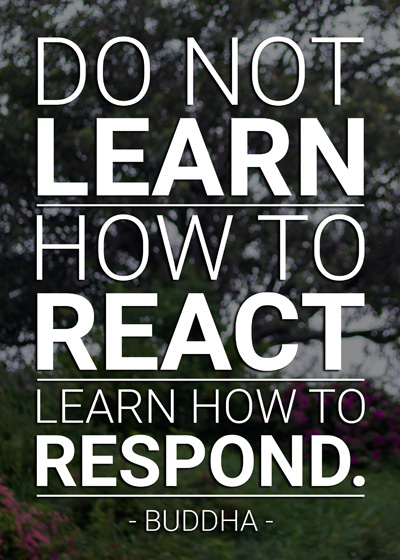
But these reactions aren’t a foregone
conclusion; we can learn to respond
rather than react. We already help students
deal with similar situations by intentionally
reflecting on them and identifying pathways
through the situations that are more
productive than the well-worn ones.
In the spirit of “Sometimes we
ALL
need this kind of help”, we offer the
same to you!
From Experience 17: Defusing and Using
Evaluation
The
CHALLENGE
is to identify situations in which you
find it difficult to respond productively
instead of reacting emotionally (in
a negative way).
First:
-
Make a list of situations where
you feel you typically overreact
or where you're not really in control
of your reactions (especially with
people who know how to press your
buttons or easily trigger you, emotionally).
-
Identify 2 or 3 of these situations
to focus on in order to analyze
your reactions.
-
Complete a
Reaction Report
for each of the situations. (The
prompts are available below; you're
welcome to copy & paste into
a document so you can truly work
through this exercise!)
Then:
-
Analyze your Reaction Reports by
completing a
Reaction Conclusion Report.
|
|
|
Reaction Report
Situation:
My typical reactions in the past:
How people
expect
me to react:
Four possible ways I
could
react:
1.
2.
3.
4.
What would be the most
productive
reaction?
What did I learn from reflecting on
this situation?
What new technique could I use?
|
|
|
Reaction Conclusion Report
1. Why I react the way I do in these
situations:
2. How I am going to
reduce
non-productive reactions in the future:
3. How I am going to respond in ways
that I can feel good about:
|
|
|
Can YOU Solve It?
A Brainteaser from
Quantitative Reasoning and Problem Solving
The following problem is found in activity
4.4: Validation
In 2023, Riley had decided to be a better
uncle and the first step was to buy
and plan to send birthday cards to all
his nieces and nephews. He had a total
of 15 (8 nieces and 7 nephews, ages
between 8 and 19) and so bought 15 cards.
|
|
|
|
At the 2023 family Christmas
dinner, when all 15 nieces and
nephews were present, Riles
loaned his tablet to each of
them so they could enter their
birth date in a new spreadsheet.
Later, when he printed out a
schedule of when to send each
of the cards, from January 1
through December 31, 2024, only
14 sets of “names+dates” showed
on the schedule.
Riley was certain he knew how
many days were in each month—he
had entered the date strings
manually, after all—so across
the 365 days from January 1
(010124) through December 31
(123124), all 15 birth dates
should have shown up on the
printout.
Thinking that one of his nieces
or nephews had neglected to
actually enter their birthday,
he printed the list of “names”
from the spreadsheet: 15.
Irritated with the software
(which had been free, after
all), he bought and downloaded
a new app and was able to automatically
transfer the data.
Unfortunately, the printed schedule
still showed exactly the same
thing: 14 cards should be sent
in 2024. Thinking that maybe
the problem was that two of
the birth dates were on the
same day and perhaps the apps
somehow assumed that meant 1
birthday instead of 2, he searched
for “shared birthdays”: 0.
Riley decided he’d have to upgrade
his tablet PC (since it obviously
wasn’t a problem with the specific
application) in order to meet
his goal of being a better uncle.
What is Riley missing? Where
did the 15th
birthday go??
|
|
|
|
Keeping an Eye on Higher Education
|
|
|
|
These
are some of the stories and trends we're
keeping an eye on.
|
|
International student enrollment has
dropped sharply, with a 17% decrease
in study permit holders from Q3 2024
to Q3 2025.
https://www.collegenews.com/article/international-student-enrollment-rate-in-us-falls/
Colleges have to prove their value to
applicants, not just the other way around
https:// www.msn.com/en-us/money/careersandeducation/colleges-now-have-to-prove-
their-value-to-applicants-not-just-the-other-way-around/ar-AA1JlBeQ
Grad PLUS Loans Will Be Ending In 2026
https://thecollegeinvestor.com/58537/grad-plus-loans-could-be-ending-in-2026/
26 Stats for 2026
https://www.insidehighered.com/news/student-success/college-experience/2025/12/19/trends-higher-education-student-success-2026
How education changed in one year under
Trump
https://hechingerreport.org/how-education-changed-in-one-year-under-trump/
And here are a couple of interesting
articles we've stumbled over and found
thought-provoking:
Colleges Are Surrendering to AI: Here’s
a better strategy for equipping students
for the age of artificial intelligence
https://www.persuasion.community/p/why-ill-encourage-my-students-to
The Resonant computing Manifesto
There's a feeling you get in the presence
of beautiful buildings and bustling
courtyards. A sense that these spaces
are inviting you to slow down, deepen
your attention, and be a bit more human.
What if our software could do the same?
https://resonantcomputing.org/
|
|
|
FREE Webinar Series
Trump and Higher Ed: Understanding the
Latest
(from the Chronicle of Higher Education)
Sign up for free today and
you’ll automatically be registered for
all three new dates, taking place once
a month January, February, and March.
Sarah
Brown, The
Chronicle’s
news editor, and Rick Seltzer, author
of
the subscriber-only Daily Briefing newsletter,
will tackle the most pressing issues
in higher-ed policy,
helping you stay informed and prepared
for what’s ahead.
-
Session 1: January 21 at 1
p.m. ET / 10 a.m. PT
-
Session 2: February 19 at 1
p.m. ET / 10 a.m. PT
-
Session 3 (Audience Q&A): March
26 at 1 p.m. ET / 10 a.m. PT
|
|
| | |