|
|
|
REFLECTIONS
Monthly News & Updates
|
|
|
|
|
This month's columns include:
-
Series: The Learning Process Methodology
-
Step 5: Performance Criteria
-
Tips & Tricks: Reinforcing Performance
Criteria in the Classroom
-
Get the
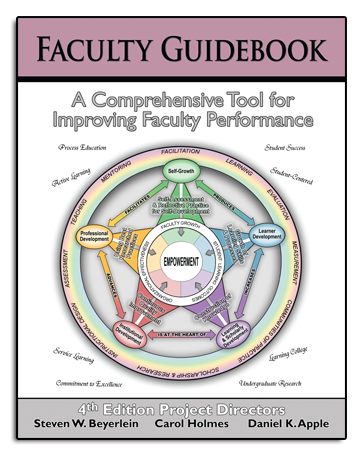
Faculty Guidebook
-
Something to Think About:
There is divine beauty in learning...
-
Monthly Self-Growth Tip: Sensing
when You're Comfortable
-
How Performance Criteria Help Duffin
Annoy the Cat
-
Showing the Target: Criteria in
Context
-
Self-Paced Teaching Workshop
-
Process Education Conference 2025
|
|
Ongoing Series:
The Learning
Process Methodology
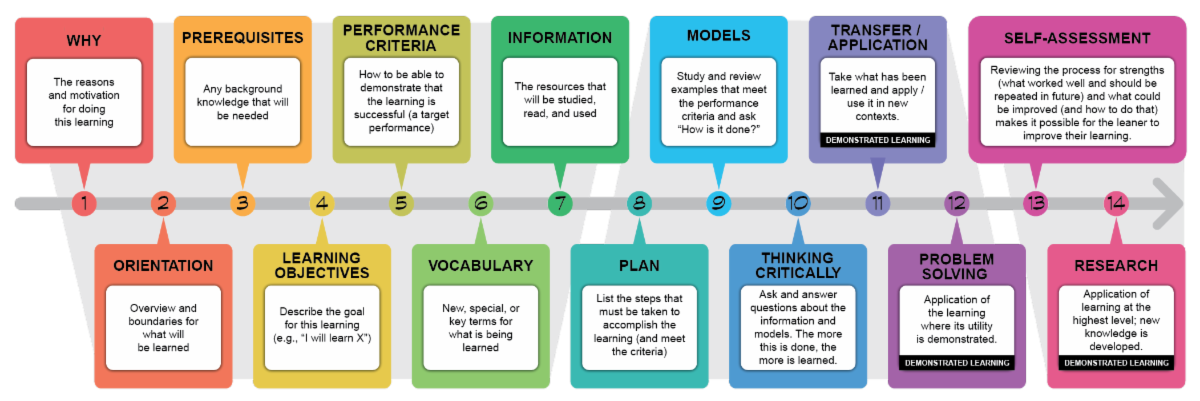
How to Learn in 14 Steps
|
|
|
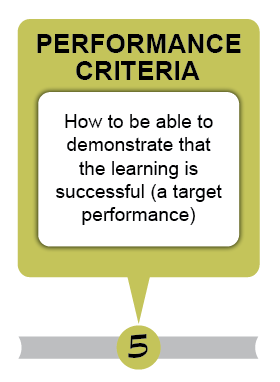
The fifth step is of the LPM is
PERFORMANCE CRITERIA
When you use the
Learning Process Methodology, the
BEST
way to demonstrate that the learning
process was successful is to
DO
something: a PERFORMANCE.
Let's take a learning objective of
learning how to identify our own fingerprint
patterns,
as a totally random example that is
non-technical, fun, and can be used
as an exemplar.
|
|
|
|
Once
we’ve gone through the steps of the
LPM focused on this objective, a perfect
target performance would be
IDENTIFYING OUR OWN FINGERPRINTS.
|
|
So the
question arises:
How do you tell whether or not your
performance is successful?
Through the use of performance criteria!
Unfortunately,
unless we’re already very familiar with
a specific performance, it can take
some work to draft performance criteria
that are “measurable,
observable,
fair,
and
challenging”
(Faculty
Guidebook
2.3.8 Learning Process Methodology).
But there’s
good news that more than makes up for
the work needed: creating performance
criteria will not only help clarify
more about how to best go about meeting
your learning objective, but also create
the optimal context for carrying out
all the other steps of the LPM.
(If I could only take 1 step of the
LPM with me to a desert island of learning,
it would definitely be “performance
criteria”.)
Definition
In short
but very professional terms, performance
criteria indicate two or three general
areas of performance and what standard
you intend to meet in each area to demonstrate
that the learning outcome has been met.
They…
-
Indicate qualities or types of performance
that will indicate achievement of
the objective
-
Describe how the learning outcome
will be measured (e.g., by
a rubric or exam)
-
Set a standard that must be met
for success (e.g., level,
grade, number of items completed)
-
Present a clear method of documenting
results (e.g., in a report
or an exam grade)
Let’s give this a try with our example
learning objective of learning to identify
fingerprint patterns.
-
Qualities/Performance: We
will
identify our own fingerprint patterns
-
Measuring: After identifying
them, we can
compare our actual fingerprint patterns
side-by-side with an identification
chart and mark our identification
of each as either correct or incorrect
-
Standard:
Let’s say that we need to
correctly identify 8 out of 10 of
our fingerprint patterns
for the performance to be a success
-
Documentation Method: We
will use a
single sheet of paper with space
for us to write down each fingerprint
pattern with X marking incorrect
and OK marking correct when
they’re compared to a visual guide.
Awesome! We’re really making progress.
Now, we need to look more closely at
the performance because while we have
decided what the
criteria
are for our performance criteria, we
still need to actually WRITE them. Luckily,
we have a useful method for doing just
that.
|
|
|
Writing Performance Criteria
Method for Developing Performance Criteria
for Individuals and Groups
(based on FGB 4.1.7 Writing Performance
Criteria for Individuals and Teams):
-
Identify key stakeholders
for the performance (who observes,
is affected, or is impacted?)
-
Describe the performance expected
by all stakeholders, including the
performer(s).
-
Brainstorm a
list of areas of quality
that can be observed within the
expected performance (think about
tasks, products, or skills).
-
Minimize redundancy and overlap
among the areas of quality
(ask: does each quality add value
to the performance?).
-
Select and
describe critical areas of quality
that most contribute to the desired
performance (ask: how does this
area of quality show itself?).
-
Clarify connections among aspects
within each area of quality in terms
of how they work together to produce
the desired outcomes.
-
Create clear statements of performance
by synthesizing relationships among
aspects within each area of quality.
-
Put the
statements in a logical order
(they can be ordered from first
observable to last in the performance,
most general to specific, or even
most to least important from the
perspective of an evaluation/test)
OK. Let’s roll up our sleeves and see
what we can do!
STAKEHOLDERS:
We’re the stakeholder because this is
something we want to do just for ourselves.
But if we were teaching someone else
to identify their fingerprints, such
as in a forensic science 101 course
for law enforcement, the stakeholders
would probably be the law enforcement
agency, the government, whether local,
state, or federal, the institution offering
the course, the person teaching it (we
would want to be a successful teacher!),
and of course the people learning. Good
thing we’re the only person concerned
about our fingerprints.
EXPECTED PERFORMANCE:
We will
identify the patterns each of our fingerprints
make.
This could be made much more official
and could be extended to identifying
a set of say 50 different latent fingerprints
from different crime scenes.
LIST AREAS OF QUALITY:
OK. This is where
we really have to drill down on the
performance. Doing some advance reading
(and after falling down a few REALLY
INTERESTING rabbit holes about the history
of fingerprints like
The Fingerprint Sourcebook), we
learn that we want to carry out the
performance of identifying them...
- without using any reference
chart (once we’ve done the work
of learning all about identifying
fingerprints in theory)
- by taking our prints rather
than just looking through a loupe,
which was our first thought but
would make it much more difficult
to evaluate our identification
- by taking no more than 2 minutes
per fingerprint
- using the 3 main types identified
by Sir Francis Galton: Arch, Loop,
and Whorl, but also the subtypes
of each: Arch (plain or tented),
Loop (ulnar or radial) and Whorl
(plain or central pocket)
- and also identifying at least
2 ridge characteristics of each
print: core, ending ridge, short
ridge, fork or bifurcation, delta,
hook, eye, dot or island, crossover,
bridge, enclosures, or specialty.
Wow. Learning
enough to write these performance criteria
is helping us learn more about the whole
subject!
MINIMIZE REDUNDANCY/OVERLAP:
We have been careful
in thinking through these aspects of
performance and there doesn’t seem to
be any redundancy or overlap. Each area
adds quality to the overall performance.
DESCRIBE CRITICAL AREAS OF QUALITY:
Areas of quality
would include
CORRECTLY
IDENTIFYING our fingerprints
as to type, subtype, and ridge characteristics
from
CLEAR
AND READABLE prints we take.
Also being able to carry out the identification
WITHIN
A SPECIFIC AMOUNT OF TIME. (These
are all aspects of the performance that
can be of higher or lower quality.)
CLARIFY CONNECTIONS:
The
prints have to be
clear
and readable
for us to
correctly
identify
them
within
a specific period of time.
STATEMENTS OF PERFORMANCE:
This isn’t a huge
performance so there aren’t a lot of
characteristics to each area of quality.
If we were going to identify prints
in order to compare a set of latents
with prints on file to try and catch
a criminal, the performance would be
much more elaborate and we would have
to think about things like how many
areas of similarity (matches) between
two sets of prints would constitute
evidence, for example. But this is all
just for fun (though now we’re invested
enough to want to learn more!) so we
can be happy enough with “clear and
readable”, using the fingerprint guide
we found online for our types (http://6enders.weebly.com/fingerprints.html),
and a kitchen timer to time our allotted
2 minutes per print.
STATEMENTS IN LOGICAL ORDER:
Our performance
is IDENTIFYING EACH OF OUR FINGERPRINTS
- Prints are
taken using a pigment ink pad and
a sheet of white paper, with each
print labelled as to hand and finger
with a space below each for us to
note information (OK. This is where
we realize that the performance
is maybe a little more complex than
we first thought because now we’re
describing a form we need to make
and use. And this is a GOOD THING
because performance criteria are
WORKS-IN-PROGRESS. The more familiar
you become with a performance and
the quality you want in that performance,
the more precisely you can describe
that performance with criteria!)
- The information
we will provide for each is major
type and subtype (arch: plain or
tented, loop: ulnar or radial, whorl:
plain or central pocket) and at
least two ridge characteristics
for each (core, ending ridge, short
ridge, fork or bifurcation, delta,
hook, eye, dot or island, crossover,
bridge, enclosures, or specialty)
- We will complete
b) for each of our fingerprints,
recording this information on our
form, within a 2-minute period of
time for each print.
We did it! It
was work but
NOT
busywork
AT
ALL because in learning enough
to write our three performance criteria,
we’ve managed to figure out
what we need to learn to learn
how to identify fingerprints (ORIENTATION).
We also found new reasons to learn about
fingerprints (WHY),
sources to read and review (PREREQUISITES
and
INFORMATION), learned a lot of
new terminology, including that what
we did is called
dactyloscopy
(VOCABULARY),
clarified our learning goals (LEARNING
OBJECTIVES), thought about how
to move forward from here (PLAN),
encountered some great graphics and
tables (MODELS),
and did quite a bit of thinking about
how we’ll assess our learning (SELF-ASSESSMENT).
While some of
these are earlier steps in the LPM and
some later, each is closely connected
to performance criteria or doing the
work to write performance criteria.
(For an independent learner, this step
is truly the one to take to the desert
island).
Teaching and Curricula
When it comes to teaching another, the
value of the performance criteria step
is most often considered in terms of
identifying and measuring quality. But
if you can help learners to
understand
what performance criteria are and how
they work, you have increased their
ability to be independent learners who
have the information and tools they
need to assess and improve their own
learning.
One of our innovations in curricula
design is to include the performance
criteria for an activity just prior
to exercises or problems, which are
really just opportunities for students
to actually PERFORM. This lets them
know
exactly
what to aim for as they begin their
work.
Recommended references
|
|
Reinforcing Performance Criteria in
the Classroom
|
|
|
|
-
Provide
written and oral clarification
of the expected level of performance
in the early stages of a learning
experience
-
Model
the level of performance and integrity
you expect
in participants/learners; invite
students to assess the performance
you model.
-
Deepen understanding of performance
criteria by
having learners assess each other’s
work
using these criteria.
(from FGB 3.1.9 Creating Meaningful
Assessment and Documentation Systems)
|
|
|
For most educators within higher education,
the discipline of teaching and learning
is a second discipline that is best
served by resources that integrate educational
theory with classroom practice.
|
|
This
is the design philosophy behind the
Faculty Guidebook
and why we touch on it in nearly every
topic we feature!
|
|
|
Something to Think About...
|
|
|
|
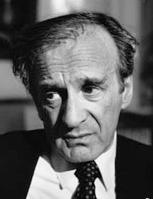
“There
is divine beauty in learning... To learn
means to accept the postulate that life
did not begin at my birth. Others have
been here before me, and I walk in their
footsteps.
”
—
Elie Wiesel
(writer, professor, political activist,
Nobel laureate, and Holocaust survivor)
|
|
|
|
Wiesel is perhaps better known for another
quote:
“What hurts the victim most is not the
cruelty of the oppressor, but the silence
of the bystander.”
|
|
|
Monthly Self-Growth Tip
Sensing when You’re Comfortable
|
|
|
“Comfort
is the enemy
of progress.”
– P.T. Barnum
|
|
|
“Life
begins at the end of your comfort zone.”
– Neale Donald Walsch
|
|
|
“The
more you seek discomfort, the more you
develop resilience.”
– Andy Molinsky
|
|
|
“If
it doesn’t challenge you, it doesn’t
change you.”
– Fred DeVito
|
|
|
The
truth is that our finest moments are
most likely to occur when we are feeling
deeply uncomfortable, unhappy, or unfulfilled.
– M. Scott Peck
|
|
|
|
All these
quotes point to a key truth:
An important characteristic of an ideal
zone of development is feeling a sense
of discomfort.
When we are, we must ask ourselves:
Why am I uncomfortable? Often it is
because we are aware of a challenge
confronting us that is beyond our current
capabilities, thereby requiring us to
grow before we can achieve success.
That means giving up our current expectations
of ourselves in favor of expecting more
and therefore doing more. Sometimes
it’s because we only believe the challenge
is beyond our current capability. In
those cases, we still have work to do
before we can succeed, but it's developing
will to try anyway, risking failure.
|
|
|
Growth only happens when the shoes of
the status quo pinch your toes.
|
|
|
More on Performance Criteria:
How They Help Duffin Annoy the Cat
|
|
|
They
say that if you judge a fish by its
ability to climb a tree, it will live
its whole life believing that it is
stupid. That’s worth keeping in mind,
but let’s back up a little bit and not
judge the goldfish (who happens to be
named Duffin).
Duffin
has absolutely no desire to climb trees,
but he IS interested in receiving our
assessment-based feedback on a performance
HE selects.
One of
the first questions we should ask is,
“What performance do you want us to
assess?”
Duffin says, “I want to work on blowing
bubbles, so give me feedback about that.”
That’s
important information but what, specifically,
will we focus on as we watch him perform
bubble blowing? Just knowing the performance
in general terms isn’t enough. We need
to know more; we need enough detail
so we can determine criteria that will
best isolate the areas of quality he
wants to improve. Does he want to improve
how many bubbles he can blow (one possible
criterion) or does he want to increase
the size of the bubbles he blows (another
possible criterion)?
“I want to blow lots of bubbles because
it annoys the cat,” says Duffin.
OK, we
can work with that! A good measure for
that criterion is bubbles per minute.
We get our stopwatch ready and can measure
how many bubbles he blows in a minute.
That data will then inform the feedback
we give.
|
|
|
Having
criteria determined and agreed upon
prior to starting the assessment process
allows both the performer and assessor
to focus on quality in this area—the
performer by producing it and the assessor
by observing, measuring, and basing
feedback on it.
Go, Duffin!
|
|
|
|
Showing the Target: Criteria in Context
|
|
|
The previous article was about criteria
and how we can’t provide a helpful assessment
without them. Recall that Duffin wanted
feedback on his bubble blowing but until
we had criteria for that performance,
we were dead in the water (sorry, Duffin).
We needed to know the criteria for Duffin’s
targeted performance—where to LOOK in
order to give the desired feedback.
And Duffin needed our feedback in order
to know what to DO to achieve his targeted
performance.
|
|
|
|
|
It usually works
the other way around
in the classroom: We know the criteria
of any targeted performance we assign
to students (what we want to SEE) and
share those criteria, effectively describing
the targeted performance for our students
(what we want them to DO). What could
be more straightforward?
|
|
|
At base, it doesn’t matter if our students
are in kindergarten or at the post-doctoral
level; their understanding of a performance
we want from them is not the same as
our understanding of it. If we’re past
our first year of teaching, we will
have seen many instances of the performance
we’re asking of them and we will have
spent a lot of time thinking about the
criteria that define the performance
target we want them to hit. Hitting
the target is what it’s all about; none
of us are trying to hide it from our
students. On the contrary, we want them
to see it clearly! This is why we share
performance criteria with them. It’s
also why we provide them with feedback
based on those criteria.
Unfortunately, to students it often
sounds like we’re saying, “I want you
to hit the target over there,” and clarifying
its location by sharing latitude and
longitude coordinates.
What can help to fill the gap between
the way we see the target and the way
our students see and work to hit it,
is a model. If a picture is worth a
thousand words, a model of a target
performance is worth a thousand performance
criteria, at least when students are
unfamiliar with the performance. It
shows them, in a way no criteria list
can, what and where the target is. Once
they see the target, they can do the
work to hit it…and at that point, the
criteria start to make sense because
they now refer to something real that
can be pointed to, discussed, and assessed,
instead of an abstract performance not
yet begun.
|
|
|
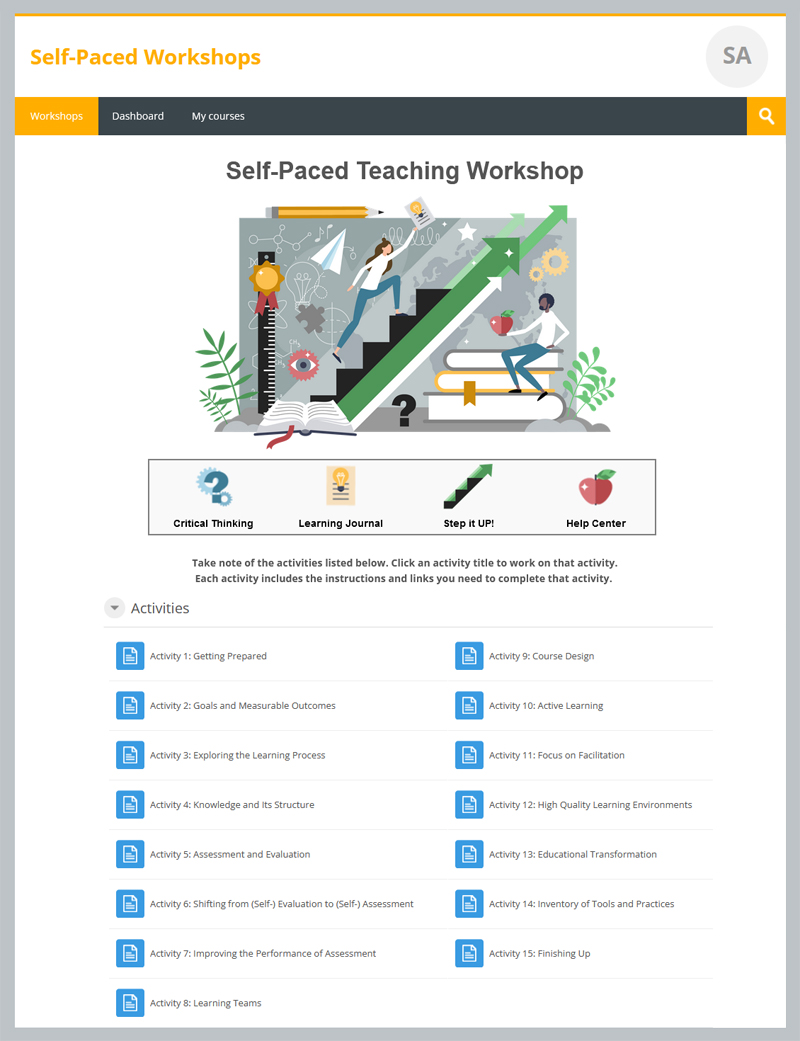
Self-Paced
Teaching Workshop
|
|
|
It’s (still) a thing!
And ready for
anyone
to use.
At an introductory cost of just $200,
it’s also an amazing value.
|
|
|
Welcome to the University of Rhode Island
participants! Your special grant-funded
registration went off without a hitch
and we’re thrilled to have you here.
If you’re
also interested in turning your classroom
into one that is learner and learning-centered,
this is the single-best offer you’re
going to get! In fact, this self-paced
workshop ALSO offers the opportunity
to grow and develop as an educator,
no matter your current level or experience.
The activities and resources provide
participants with a greater understanding
of Process Education/active learning
and key educational processes (learning,
teaching, curriculum and activity design,
and assessment). Numerous tools and
techniques are introduced to help faculty
facilitate students’ skills with respect
to critical thinking, assessment, cooperative
learning, journal writing, guided discovery
learning, and problem solving.
|
|
The 2025 PE Conference is hosted by
the
Academy of Process Educators
and the University of Indianapolis (UIndy)
Tuesday, June 3 through Thursday, June
5
1-day pre-conference workshop
(Developing
Performance to Unlock Your Limitless
Capability)
on
Monday, June 2
Breakout sessions will be focused on:
-
Innovating with PE Tools & Techniques
for the Post-Covid Era
-
Leveraging Instructional Technologies:
AI, LMS, eLearning, Distance Education
-
Reconciling Life’s Challenges
-
Enhancing Reflective Practice
-
Deploying Learner-Centered Communication
-
Incorporating International Perspectives
-
Advancing Wellness & Self-Care
-
Cultivating Mentorship
Other information:
The conference will be presented in
a hybrid format. In-person participation
at the University of Indianapolis is
encouraged
because of the many advantages of sharing
time and space together. However virtual
options for participating will be available.
|
|
| | |