|
|
|
REFLECTIONS
Monthly News & Updates
|
|
|
|
|
This month's columns include:
-
Series: The Learning Process Methodology
-
Step 4: Learning Objectives
-
Challenge: Identify the Type of
Learning Objective
-
Something to Think About: Looking
Fear in the Face
-
Monthly Self-Growth Tip: Processing
Weekly Carryover
-
Making the Important Things Matter
-
Self-Paced Teaching Workshop
-
A New Year and a New Beginning
|
|
Ongoing Series:
The Learning
Process Methodology
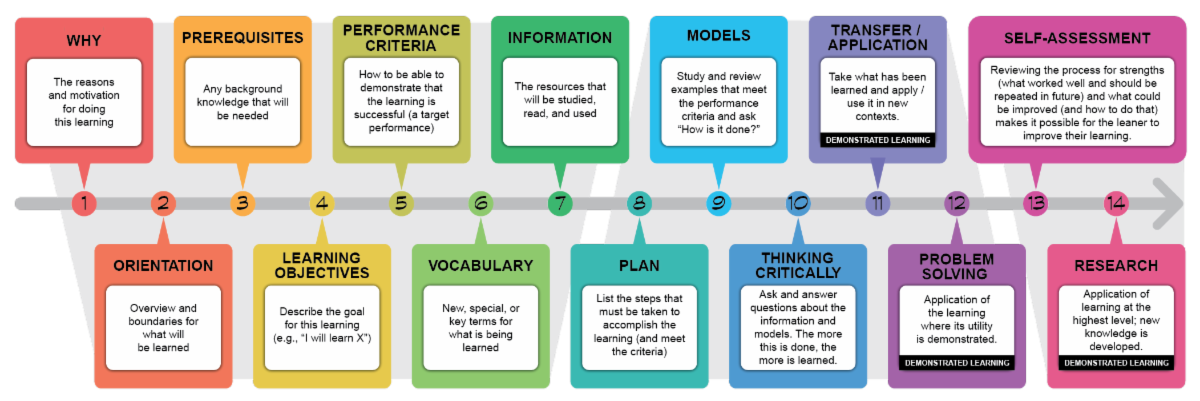
How to Learn in 14 Steps
|
|
|
The fourth step is of the LPM is
LEARNING OBJECTIVES
These specify
the knowledge, skill outcome, or result
that you intend to achieve as a result
of learning. They should be personally
meaningful, relevant, valuable, motivating,
and supportive of your larger learning
goals, and always be specified as positive
achievements!
Learner and learning performance are
more likely to improve if we can precisely
define
what
is to be achieved with respect to learning,
along with
how
the learning performance can be documented
at the end of a learning experience.
|
|
|
|
Types of Learning Objectives
Our preferred paradigm consists of five
different types of learning objectives
that are common in education:
competencies,
movement,
accomplishments,
experiences,
and
integrated performance.
Each addresses a different aspect of
learning and is best suited to specific
educational methods and requires collecting
different types of evidence to demonstrate
that the learning objective has been
achieved.
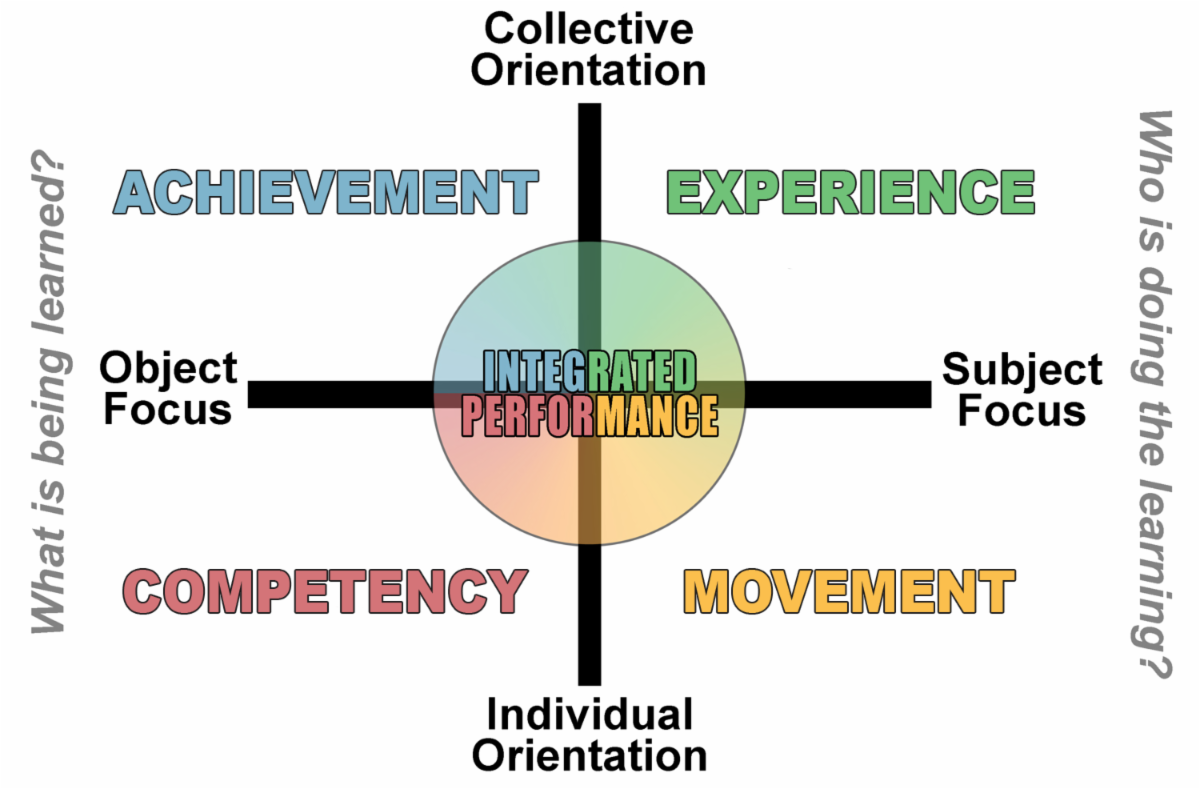
Learning is a social enterprise that
contains elements that can be mapped
on two axes. One axis is defined by
what
is learned (object) versus
who
is involved in the learning (subject);
the other axis is defined by whether
the learning has more of an
individual
or a
collective
orientation. When these axes intersect,
as shown in Figure 1, four different
regions emerge that suggest
distinctive
educational activities and objectives.
On first blush, it may seem that this
approach to learning objectives is needlessly
complicated but it is this richer formulation
that suggests to teachers (and learners!)
an array of activity types and assessment
tools, as well as fruitful perspectives
for classroom research.
Figure 1
Types of Learning Objectives Mapped
to the Axes of Social Learning
|
|
|
Competency Objectives
(object
focus, individual orientation)
Competency objectives are tasks that
learners must perform at a prescribed
level. These performance levels are
often referenced to disciplinary standards
and/or accreditation criteria. Competency
objectives are snapshots of what learners
can do at a specific point in time,
and they are relatively easy to measure.
Special attention should be given to
exactly what levels of knowledge are
expected so that these objectives reach
the appropriate level in Bloom’s Taxonomy
(information, conceptual understanding,
application, working expertise, or research).
-
Classroom Research Question:
What can the learner do at what
level in a specific situation?
-
Common Learning Activity:
guided-discovery; active learning
-
Common Assessment Tool:
exams with scoresheets
|
|
|
Movement Objectives
(subject focus, individual orientation)
Movement objectives focus on personal
and professional development. They prescribe
a desired direction and magnitude of
growth that extend well beyond the present
capabilities of all learners. Movement
objectives require multiple samplings
over time to document whether real growth
has occurred.
-
Classroom Research Question:
What does increased performance
look like?
-
Common Learning Activity:
study of processes; use of tools
-
Common Assessment Tool:
self-growth papers
|
|
|
Experience Objectives
(subject focus, collective orientation)
Experience objectives capture changes
in attitudes, values, and behaviors
that result in a life-changing experience.
They should reveal awareness and critical
analysis of the causes and impacts of
personal changes in the learner. When
the learner processes the experience,
it should produce new understanding
that can be shared with others through
purposeful reflection and self-assessment.
-
Classroom Research Question:
How has this shared experience changed
the learner?
-
Common Learning Activity:
team building; contests
-
Common Assessment Tool:
personal interviews; focus groups
|
|
|
Accomplishment/Achievement Objectives
(object focus, collective orientation)
An example of an accomplishment objective
would be a major work product or creative
performance that is significant within
a disciplinary field. They usually represent
clear endpoints and can often be archived
for future reference or study. When
measuring accomplishment objectives
, it is possible to eliminate instructor
bias by getting outside affirmation
from other faculty, alumni, or practitioners
in a field. Often these objectives can
be evaluated and celebrated at the same
time in a public display. Frequently
they can also be listed on a student’s
resume documenting their ability to
perform in specific areas.
-
Classroom Research Question:
How well does student work compare
with work products of practitioners
in the field?
-
Common Learning Activity:
project work
-
Common Assessment Tool:
judging work products
|
|
|
Integrated Performance Objectives
(multiple combinations of the four outcome
types)
Integrated performance objectives draw
on previous types of learning and experiences
from multiple sources. They require
extension and transfer of knowledge,
skills, and perspectives in a professional
environment. This type of objective
must be measured in a challenging and
compelling situation that ensures peak
performance on the part of the learner
in a relatively short period of time.
Integrated performance can be studied
at the beginning of a course as a pre-assessment
activity or at the end of a course as
a summative evaluation. Integrated performance
objectives are especially efficient
and effective in answering questions
connected with program assessment.
-
Classroom Research Question:
How prepared are students to respond
to a real-world challenge?
-
Common Learning Activity:
role playing; problem solving
-
Common Assessment Tool:
panel of mentors or colleagues
|
|
Something to Think About...
|
|
|
|
“We gain
strength,
and
courage,
and
confidence
by each experience in which we really
stop to look fear in the face… we must
do that which we think we cannot.”
—
Eleanor Roosevelt
|
|
|
|
By FDR Presidential Library & Museum
- www.flickr.com/photos/fdrlibrary/50517137801/,
CC BY 2.0, commons.wikimedia.org/w/index.php?curid=156984585
|
|
|
|
|
Monthly Self-Growth Tip
Processing
weekly carry-over
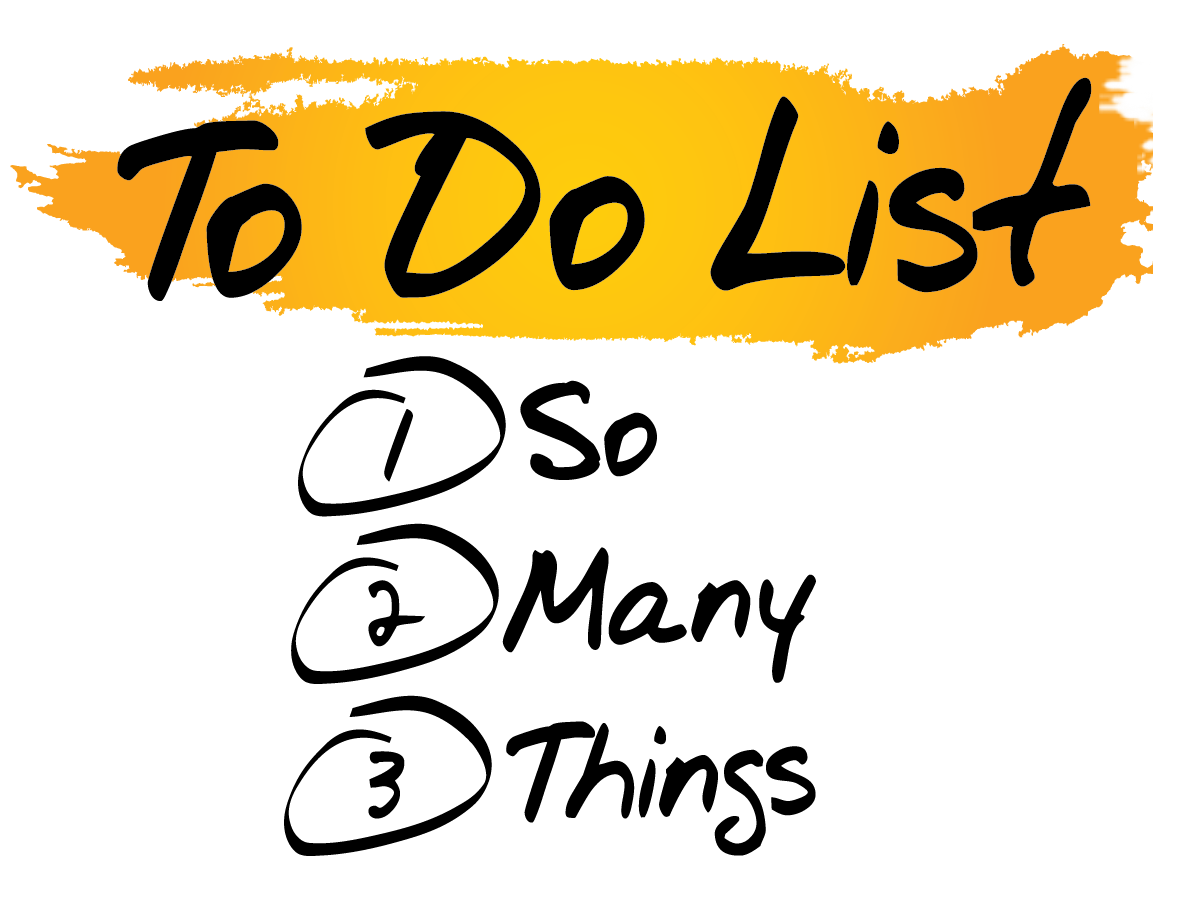
When a to-do-list expands beyond a reasonable
level, you need to apply new strategies!
|
|
|
-
Sort and rank the list based on
urgency
and
importance.
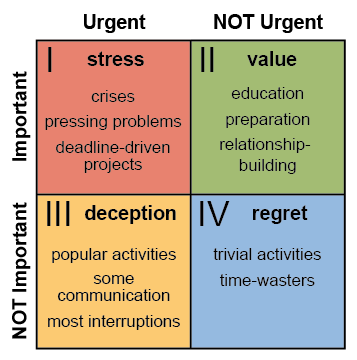
(See the Time Management Matrix
in the article below.) Then determine
which items have dire consequences,
if any.
-
Determine which items can be delegated
without serious ramifications.
-
Defer some of the items by a week
(if possible) to see if maybe they
become less important.
-
Find new ways of achieving certain
items in less time at a similar
level of quality (increase your
efficiency).
-
Finally, postpone starting anything
new
until your to-do-list is once again
manageable.
|
|
Making the Important Things Matter
|
|
|
President
Dwight D. Eisenhower said,
“Most things which are urgent are not
important,
and most things which are important
are not urgent.”
He is known to have made use of a matrix
which is now sometimes called the Eisenhower
Matrix or Importance-Urgency Matrix.
|
|
|
Author
and professional speaker Stephen Covey
included a revised version of the matrix
in his best-selling book
The Seven Habits of Highly Effective
People,
shining a well-deserved spotlight on
this useful analytical tool.
All too
often we confuse
interesting
with
important.
Given the sense of urgency that pervades
so much of modern life, where messages
as well as coffee are “instant,” another
trap is confusing what is important
with that which is merely urgent. Covey
writes,
|
|
|
|
It’s important to realize that urgency
itself is not the problem. The problem
is that when urgency is the dominant
factor in our lives, importance isn’t.
What we regard as ‘first things’ are
urgent things. We’re so caught up in
doing, we don’t even stop to ask if
what we’re doing really needs to be
done.
The Time
Management Matrix (shown above) can
help you focus your time and energy
on
what’s most important
and avoid those activities that are
less important or not important
to you.
While
the Matrix is incredibly useful for
professionals, it may be even more important
for students, as they generally have
not yet developed critical learning
skills such as prioritizing. We recognize
this and have an entire chapter and
activity devoted to time management
in our
Learn to Learn for Success course!
|
|
|
Self-Paced Teaching Workshop
|
|
|
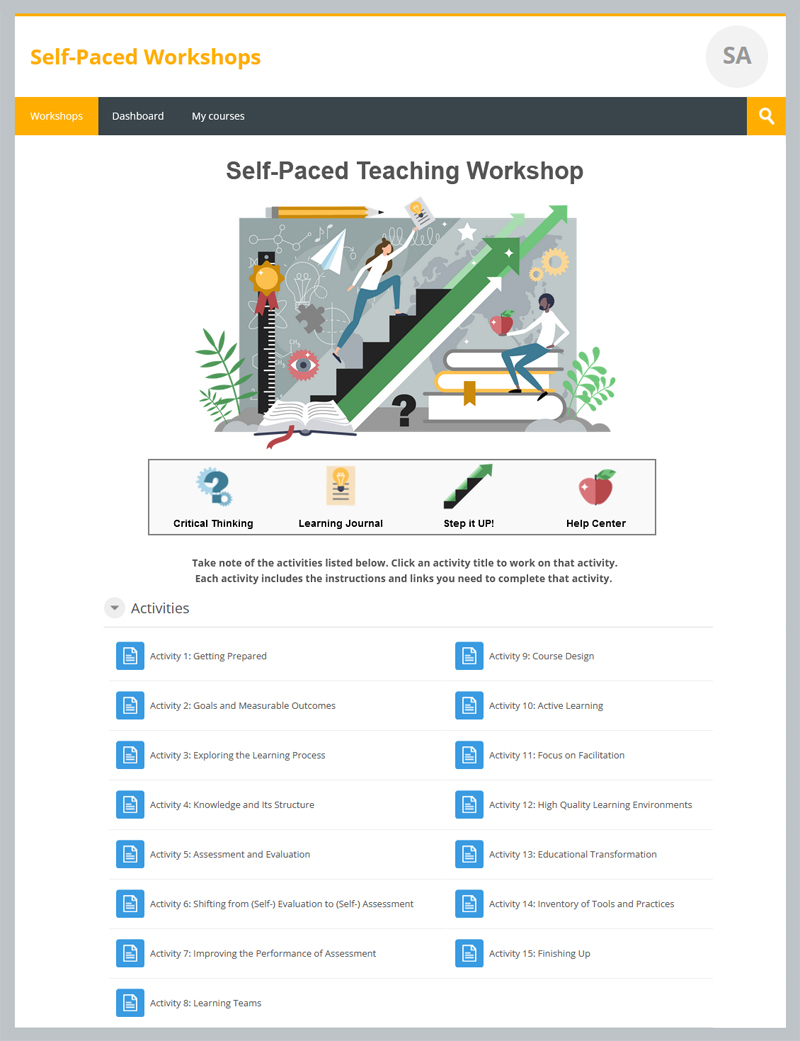
It’s a thing!
And ready for
anyone
to use.
At an introductory cost of just $200,
it’s also an amazing value.
|
|
|
If you
tried the
Learning Objectives Challenge,
you had a little taste of how thoughtful
and interesting learning is in the Self-Paced
Teaching Workshop. While we've gamified
some aspects of learning, what we haven't
done is cut back on the content that
helps participants convert from a traditionally-oriented
classroom to one that is learner and
learning-centered. In fact, this self-paced
workshop offers the opportunity to grow
and develop as an educator, no matter
your current level or experience. The
activities and resources provide participants
with a greater understanding of Process
Education/active learning and key educational
processes. It will help you to:
-
Challenge yourself and your students
-
Move from memorizing to problem
solving
-
Go from faculty-centered to learner-centered
-
Transition from presentation to
active learning
-
Learn to create responsive curricula
-
Explore the value of cooperative
learning
-
Increase belief in your own efficacy
and that of your students
-
Learn to use assessment as a powerful
alternative to evaluation
-
Find ways to meaningfully measure
the quality of performance
-
Engage in self-directed learning
(and learn how to facilitate it!)
-
Become invested in growth for yourself
and learn how to foster it in your
students
|
|
|
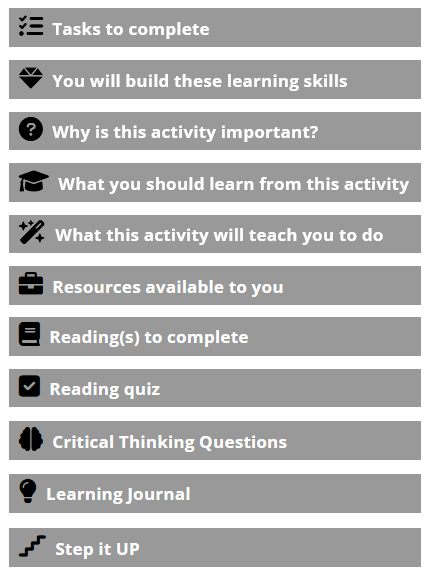
If you’ve been
following along with the Learning Process
Methodology feature in the last several
newsletters, the parts of each activity
in the Self-Paced Teaching Workshop
will look familiar!
We use the LPM
to design our activities because it's
how
people learn. Not only do teachers
learn how to
teach more effectively in the
Teaching Workshop, they also Learn How
To Learn.
This firsthand
experience makes it possible for them
to pass it along…no matter their discipline,
they can then teach their students how
to learn. And when you can do that,
the sky is the limit.
|
|
|
A New Year and a New Beginning
|
|
|
We tend
to look to the new year as a clean slate
and a chance for a new beginning. Except
that as anyone who has made New Year’s
resolutions knows, the choices and actions
of our yesterdays loaded today with
momentum and it is extremely difficult
to escape the gravity well of genes,
habit, and history. It is always easiest
to keep walking the path we’re on…it
is usually the path of least resistance.
Or at least the resistance we're familiar
with.
In the
book
Endymion
by Dan
Simmons, a character considers how to
give the best possible message of hope
to humanity—a
kind of updated sermon on the mount.
Her goal was to pare this message down
to its most critical essence. She worked
on it for years and finally got it down
to two words.
CHOOSE AGAIN.
With
every single breath, you can choose
again. You can make a different choice
or the same choice you made before.
The point is that you choose again.
What went before is nothing compared
to what you can do by choosing again,
right now. Making a choice, though only
the work of a moment, is a brave act
of will and participation that makes
your life intentional. The consequences
of your choice will often be a transition
that you will work through and sometimes
it takes a great deal of time and effort,
depending on the choice you’ve made.
But if you are ready for a new beginning,
to do more than move forward on the
momentum that brought you to this time
and place, choose again.
Choices
don’t have to be big to make a difference,
especially in our lives. A small pebble
cast into a pond sends out waves in
every direction. Choosing to turn off
the TV, to watch a sunrise, to smile
at a stranger, to not do something we’d
ordinarily do, or to do something we
usually wouldn’t…these are small things
but each of them sets us on a new path
and changes the course of what went
before. Even choosing again what we
chose before is a profound act, as it
affirms our intention and renews our
commitment to our choice.
|
|
| | |