|
|
|
REFLECTIONS
Monthly News & Updates
| |
| |
|
This month's columns include:
- Series: The Learning Process Methodology
- Step 2: Orientation
- Something to Think About: Teachers Who Inspire
- We Must have a Plan to Deal with the Serious Negative Hits of Life
- Monthly Self-Growth Tip: Letting Cognition Manage Affect
- Thinking About Persistence
- Contextualizing Learning Skills: Recording
|
|
Ongoing Series:
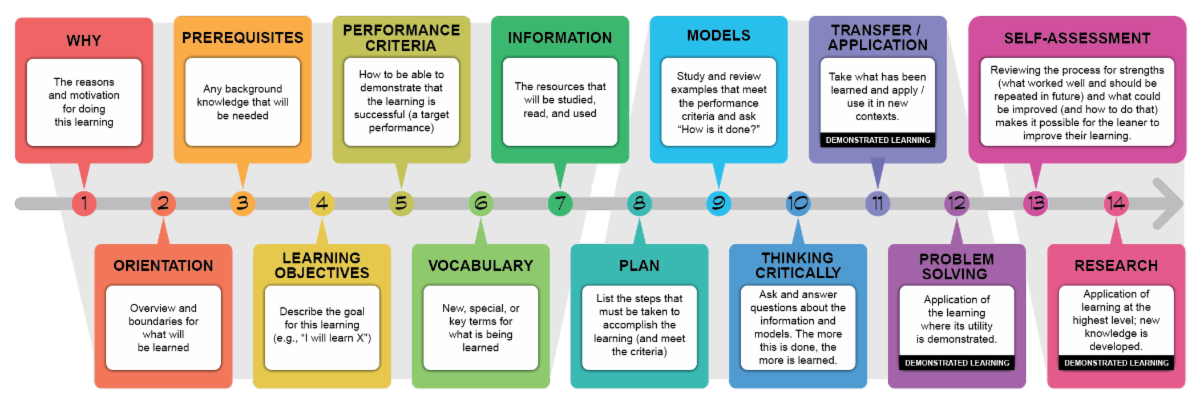
The Learning Process Methodology How to Learn in 14 Steps
| |
|
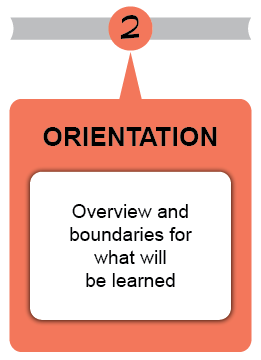
The second step is of the LPM is ORIENTATION
This
is the overview and boundaries for what will be learned and includes
reviewing instructions, materials, and the main focus of what will be
learned about the topic.
A
strong orientation statement indicates the context, such as a course
assignment or a research project and also demonstrates awareness of the
overall topic or area of knowledge (e.g., factoring problems in algebra
or hormone systems in biology.
| |
|
|
It
should not come as a surprise that the Learning Process Methodology is
ALSO a sort of blueprint for designing LEARNING activities. The LPM is a
proven FORM without specific CONTENT, after all. Once you determine
what that content should be, then you can use the LPM to design a
specific learning activity.
The
ORIENTATION step of the LPM correlates to the FOCUS of a learning
activity, and functions as a concept map or table of contents.
In The Learning Process Methodology: A Universal Model of the Learning Process and Activity Design, educator and author Matthew Watts explains the importance of this step:
A
systematic overview is developed to identify what is to be learned and
how it relates to other knowledge. It has been shown by Hicks and
Klimoski (1987) that a proper preview of the learning activity results
in a greater commitment to and satisfaction with the subsequent
learning. A discovery activity supports the Orientation step of the LPM
as it sets the context and area of knowledge prior to dispensing
information. Dewey (1944) argued long ago that new ideas should be
introduced with “something to do, not something to learn”, comparing
each learning activity to an act of experimentation performed by a
scientist in a laboratory. To best encourage learners to explore the
essential content’s core, an interesting, intriguing, and fun activity
is advised for inclusion into the learning experience. An interactive
discovery activity agrees well with the first step in Kolb’s
Experiential Learning Cycle – concrete experience. Thus by exploring and
experimenting a successful learning environment is established
(Bransford, Brown, & Pellegrino, 2000).
Thus
motivation doesn't end with Step 1: Why, but continues through Step 2:
Orientation. Think of it this way: When we're hungry, we eat. It's a
necessity and hunger itself is motivating. But think of how awesome it
can be to browse a menu at a nice restaurant. Each dish is described in
ways that orient us what our eating experience could consist of and the
more mouth-watering the description, the more we look forward to eating.
It isn't a perfect analogy but it does get to the heart of how
important orientation can be to the anticipated experience of learning.
| |
Bransford, J., Brown, A., & Pellegrino, J. (Eds.) (2000). How people learn: Brain mind, experience, and school (Expanded ed.) (p. 209). Washington, DC: National Academy Press.
Dewey, J. (1944). Democracy and education. New York, NY: The Free Press.
Hicks, W., & Klimoski, R. (1987). Entry into training programs and its effects on training outcomes: a field experiment. Academy of Management Journal, 30(3), 542-552.
Kolb, David A. 1984. Experiential Learning: Experience as the Source of Learning and Development. Englewood Cliffs, NJ: Prentice-Hall, Inc.
| |
Something to Think About... | | |
|
|
"I
have been most inspired by those teachers who have had the courage to
transgress those boundaries that would confine each pupil to a rote,
assembly line approach to learning. Such teachers approach students with
the will and desire to respond to our unique beings, even if the
situation does not allow the full emergence of a relationship based on
mutual recognition. Yet the possibility of such recognition is always
present."
--bell hooks
| | |
|
We Must have a Plan to
Deal with the Serious
Negative Hits of Life
| |
|
|
There is an old
adage that says “Into each life, some rain must fall,” or, putting it
another way, “Stuff happens.” Taking negative hits is a part of growth.
It does not matter how many blows or hits we receive; what does matter
is how we respond to them. The best way is by picking ourselves up,
dusting ourselves off, and continuing on. Making a commitment to dealing
with the negative hits life brings can mean the difference between
destructive and constructive behaviors in our moments of distress.
The strength of our
affective skill set (our grit and how we cope and respond,
emotionally), the strength of our identities, and our belief in our own
ability to make a difference (our efficacy) are, to a very great degree,
what determine the quality of our life, now as well as in the future.
“Everything
can be taken away from a man but one thing: the last of the human
freedom—to choose one’s attitude in any given set of circumstances, to
choose one’s own way.”
—Viktor Frankl
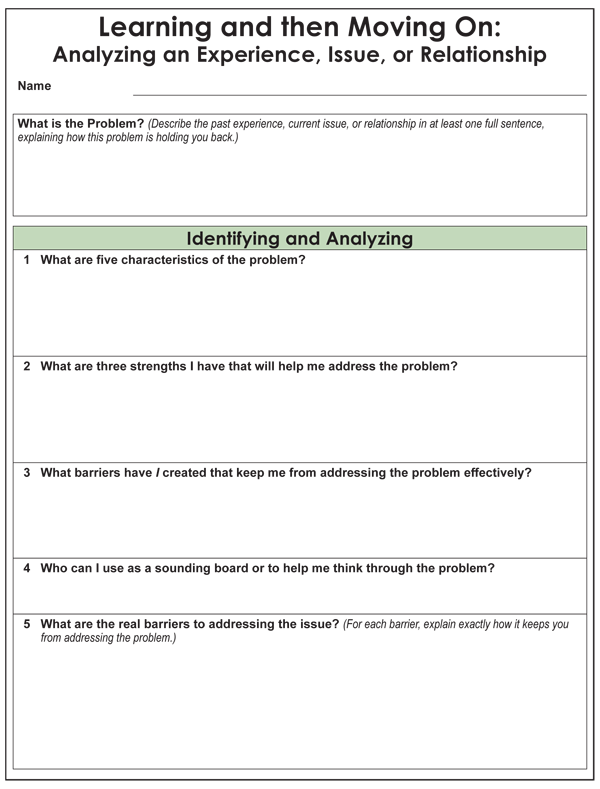
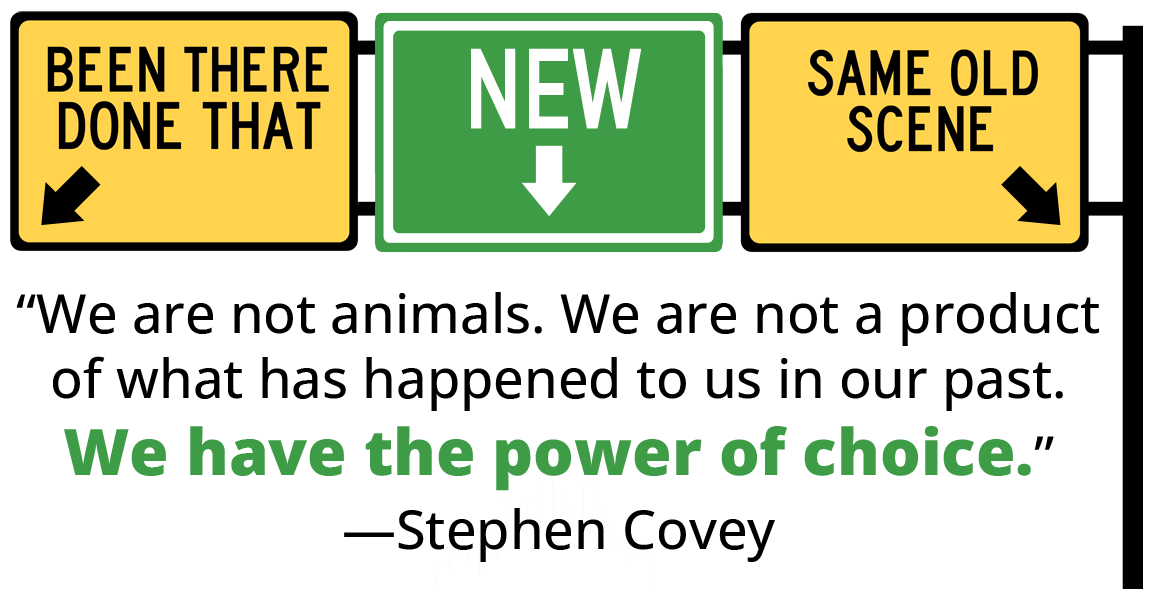
In our first-year course book Learn to Learn for Success,
Chapter 3 “My Past Doesn’t Define My Future” challenges students to
closely examine a past or present experience, issue, or relationship and
then find a way to leverage it so that it can contribute productively
to the way they approach the future. Students first select one of two
scenarios where the main character has suffered a serious setback or
circumstances that negatively impact their life. They are then asked to
complete a Learning and then Moving On: Analyzing an Experience, Issue, or Relationship worksheet
as if they were the main character. This gives them practice in
thinking through these difficult setbacks without also needing to sort
through their own feelings.
| |
After
that practice and a bit of cognitive stretching (answering some
Critical Thinking Questions), they are then asked to focus on an issue,
experience, or relationship that is problematic and potentially holding
back their growth. When they’re ready, they do hard work to develop a
plan for constructively addressing it by completing the same Learning and then Moving On worksheet. This exercise is so useful and powerful that we integrated it into the Self-Growth Institute. | |
And now we offer it to you
in your choice of formats: a pdf form that can be printed or an online
interactive "worksheet". Simply respond to the prompts and when you're
finished, you can download the prompts and responses. We save absolutely
nothing; your work is your own. Click the image below for your
preferred version. | |
|
Monthly Self-Growth Tip:
Letting Cognition Manage Affect
| | |
|
|
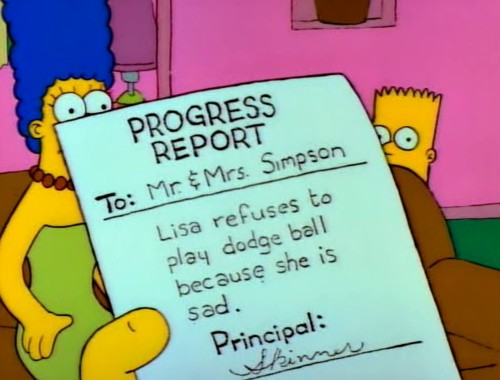
When Lisa is too sad to play dodge ball, Marge tells her:
“It
doesn't matter how you feel inside, you know. It's what shows up on the
outside that counts. Take all your bad feelings and push them down, all
the way down past your knees, until you're almost walking on them. And
then you'll fit in, and you'll be invited to parties, and boys will like
you.”
| |
|
Psychology tells us this strategy can maybe work for a little while. But it’s like filling a hole with dirt by digging a new hole. There’s still
a hole. Dealing with the hole of sadness (or any strong emotion)
doesn’t mean climbing into the hole and living there. It means thinking
through (or alongside) the feelings to figure out what we need to DO.
Being thoughtfully aware of and managing our emotions keeps us from
being sabotaged by them. That’s what self-growth is, after all. And
there are lots of learning skills that can help us do that:
-
Being metacognitive: stepping back to better understand one’s thinking, affective, and social learning skills
-
Gaining perspective: navigating among multiple vantage points to obtain true understanding
-
Being philosophical: gaining deeper understanding of the nature of life and its meaning
-
Maintaining objectivity: focusing on reporting the feedback, not responding to personal reactions
-
Being non-judgmental: withholding or avoiding using one’s personal standards or opinions
-
Being patient: waiting with equanimity when timing, conditions, and readiness are not right
-
Changing reactions: purposefully trying out new or alternative reactions to specific feelings
-
Trusting self: knowing that your values and capabilities are the most relevant to your situation
-
Controlling overreactions: striving for moderation in responses
- Disengaging emotionally: taking a time out when feelings dominate rational thought
-
Sensing emotional confusion: realizing that unclear feelings must be dealt with
-
Being stoic: accepting that life situations often create discomfort for a time
-
Seeking help: accepting that you need outside assistance and asking for it
-
Responding to loss: adjusting to ongoing feelings related to disappointments and grief
-
Perceiving emotions: recognizing and identifying your own affective responses
|  | |
Thinking About Persistence... | |
|
According to Merriam-Webster’s Dictionary,
persist: to go on resolutely or stubbornly in spite of opposition, importunity, or warning
Consider
the Greek myth of Sisyphus, who was punished by Zeus for his hubris
(daring to think himself more crafty than the gods). He was required to
push a heavy boulder up a hill for eternity. Each time Sisyphus neared
the top, the boulder would roll back down, forcing him to start again.
Sisyphus was persistent — whether by choice or requirement; he went
resolutely on pushing that boulder up the hill. Sisyphus is always seen
as a tragic figure, doomed to never get the boulder to the top.
With all this in mind, let's review the rubric for “Persistence”:
| |
| Level 5—Champions
- Refuse to be frustrated in any situation and get back in action instantaneously
- Have such extreme drive and internal motivation that they have high confidence in all situations
- Are process experts and value every moment they live
- Have endless patience and quickly adapt successfully to the most challenging situations
- Are highly organized toward a well clarified vision
| | Level 4—Professionals
- Are good at managing frustration and can’t be kept down for long
- Have high drive and internal motivation and have confidence in most situations
- See the value in process and value most moments
- Are usually patient and seek to adapt to the most challenging situations
- Are well organized and have a set of prioritized actions toward a clearly prioritized set of goals
| | Level 3—Reliable Individuals
- Consistently manage their frustration, thus rarely give up before success
- Have moderate drive and some internal motivation that they have confidence in many situations
- Appreciate the process and enjoy many moments
- Are generally patient and frequently adapt to new situations
- Are consistently organized and able to articulate valued goals and act on them
| | Level 2—Unreliable Individuals
- Are not consistent in managing their frustration, thus frequently give up
- Have occasional drive from external motivation with confidence in familiar situations
- Routinely whine about the process and thus enjoy easy-to-obtain efforts
- Sometime exhibit patience and are somewhat adaptable to different situations
- Are poorly organized and have vaguely stated goals without prioritization
| | Level 1—Quitters
- Can’t manage any frustration, thus crash and quit permanently
- Have such low drive they don’t respond to external motivation thus have no confidence of success
- Do not see the value of the process so they only enjoy instantaneous results
- Give up easily and won’t try to adapt to the situation
- Are disorganized and unable to articulate and thus progress towards goals
| | |
|
It is possible that the very act of persisting matters.
Novelist and playwright Samuel Beckett wrote
"I must go on, I can't go on, I'll go on."
He also wrote
"Try again. Fail again. Fail better."
Maybe
the boulder we're pushing gets a little nearer the top each time. Or
maybe we're getting stronger, the longer we push. Perhaps others see us
persisting and are inspired by our commitment and maybe even the grace
we show when the boulder rolls back down and we start again. Or, as philosopher Albert Camus wrote,
"The struggle itself toward the heights is enough to fill a man's heart. One must imagine Sisyphus happy."
| |
Recording: capturing information and representing it some medium
| | |
|
Before
children are able to write quickly enough to capture information,
simply introduce the idea of recording. Use pictures and video of
special occasions (birthdays, etc.), journaling, and even memory
(telling them about something special you remember from when you were a
child). | |
|
A nice way to work
with journaling before a child can write is having the child tell about
their day, each day, and you record it. Ways to explore recording might
include trips to places like a zoo, park, or farmer’s market and then
encouraging the child to draw what they saw. Other media work well too,
including clay, Legos, matchsticks, and so forth. A sketch book and
colored pencils makes for a terrific gift for grade school children,
especially if you take them places and encourage them to capture and
represent things they see.
| | |
|
The
point for most college students is to deal with recording BEYOND
NOTE-TAKING! The idea of recording should be dealt with in its own right
as selectively capturing information, no matter the course or medium
used. Any writing course can confront what we choose to record and our
reasons & motives for those choices. | |
|
Comm students might
study sub-titles and transcripts for what was captured and what wasn’t.
History courses might use Civil War journals, memoirs, biographies, and
autobiographies to grapple with the same issue. Philosophy students can
deal with the difference between a thing and its representation. All
students need to learn to be skeptical about representing information
for specific purposes and with an agenda.
| | |
|
The
point for most college students is to deal with recording BEYOND
NOTE-TAKING! For STEM students, ask “What goes into a lab notebook?” and
offer historical examples of scientists (Darwin, Einstein, Margaret
Mead, Marie Curie, etc.) capturing information. How did they ultimately
represent that information? | |
|
Work with math
students and ask why we prefer that students in math show their work
(record it). Introduce “math as a representation of ideas” and number
theory. For all STEM, “What are models?” is well worth asking and having
students deal with. Try to build sensitivity to representation and how
we choose to capture and represent information; why don’t we trust
statistics? The topic of reverse engineering is rich; with it, we take a
representation and try to recover the information within or represented
by it.
| | |
|
|
Create occasions
where everyone experiences the same thing (a trip to a museum or
similar) then represents their experience. Choose a medium for all to
use or draw for your medium out of a hat (words, drawing, re-enactment,
etc.) Have everyone share a 'recording' of an experience and see if
others can guess what it was. Visit an art gallery and talk about
information and representation as you view the art...
| | | | |