|
|
|
REFLECTIONS
Monthly News & Updates
|
|
|
|
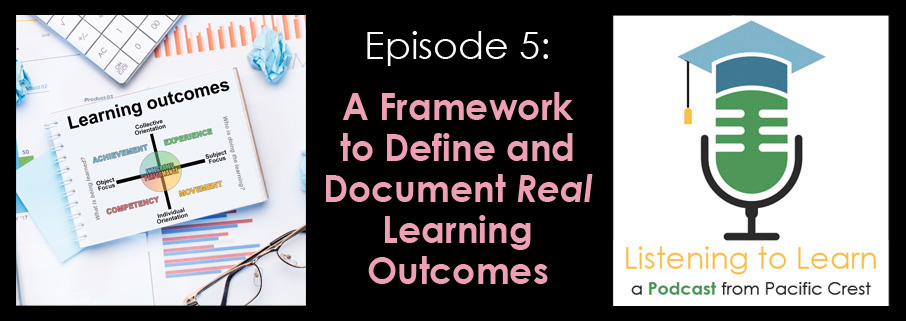
Episode 5
A Framework to Define & Document
REAL Learning Outcomes
|
|
|
This episode examines the importance
of learning outcomes in education, emphasizing
that clearly defined goals improve learner
performance and guide effective instruction.
It introduces a preferred framework
consisting of five distinct types of
learning outcomes: competencies, movement,
accomplishments, experiences, and integrated
performance. Each type is uniquely suited
to different educational methods, requires
specific forms of evidence for documentation,
and addresses varying aspects of learning.
We share details about the characteristics,
associated learning activities, real-world
examples, and assessment tools pertinent
to each of the five learning outcome
types. Ultimately, the goal is for educators
to understand how they can utilize a
diverse range of measurable and motivating
outcomes to meet broader program and
learning expectations.
|
|
Based on
Faculty Guidebook
modules focused on Learning Outcomes.
Created with the help of Notebook LM.
|
|
Ongoing Series:
The Learning
Process Methodology
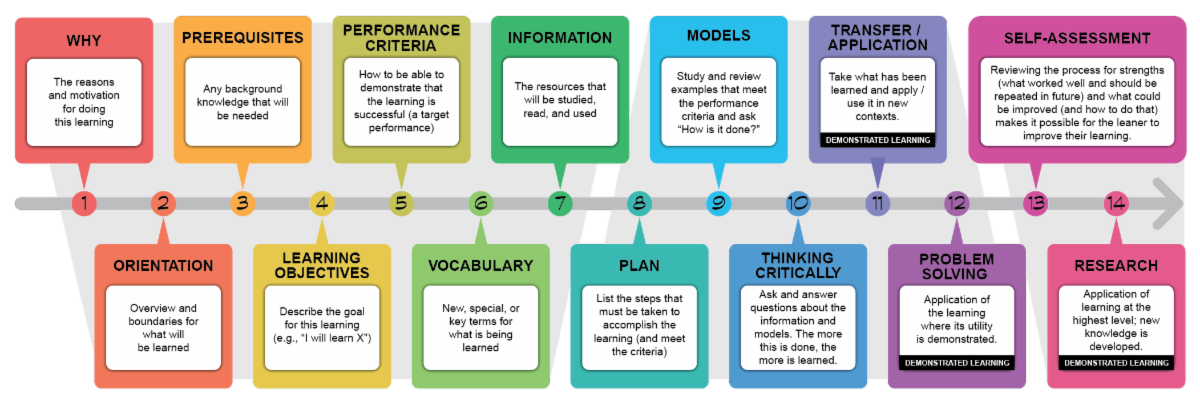
How to Learn in 14 Steps
|
|
|
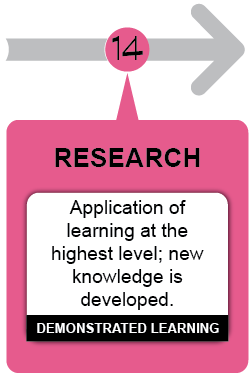
The 14th
and final step of the LPM:
Research
Note the gray arrow pointing to the
right. We’ll see in this article that
while Step 14 may be the last step of
the LPM, it is most
emphatically
NOT
the end of learning!
|
|
|
|
Most of us don’t stop to think about
what we mean when we use the term
research;
we just assume that we’re all on the
same page, definitionally. But there
are (at least) two very different ways
to come at the idea of research.
Consider the following pair of sentences:
-
“I spent an hour researching the
best way to season a cast iron pan.”
(Source: Me, Denna Hintze)
-
Research has proved that gray cast
irons, ductile irons, and austempered
ductile irons are ferrous cast materials
that have undergone different austempering
heat treatment conditions, resulting
in the production of new materials
that have high strength-to-weight
ratios with very tough and strong
properties.”
(Source: Akinribide OJ, Ogundare
OD, Oluwafemi OM, Ebisike K, Nageri
AK, Akinwamide SO, Gamaoun F, Olubambi
PA. A Review on Heat Treatment of
Cast Iron: Phase Evolution and Mechanical
Characterization.
Materials
(Basel). 2022 Oct 13;15(20):7109.
doi: 10.3390/ma15207109. PMID: 36295181;
PMCID: PMC9605181.)
Though the research carried out in both
cases
filled a gap in knowledge,
where that gap resided is what we're
interested in. For sentence 1, the gap
was in my own knowledge. I realized
I didn’t know how to season a new cast
iron pan…at least not for sure. I wasn’t
certain what kind of oil I should use
or if I could season the pan on the
stove instead of in the oven. For sentence
2, however, the gap was in the knowledge
of either the scientific community or
humanity in general.
Related to the gap in knowledge, but
from another direction...
The Roman statesman Cicero was fond
of using the phrase “Cui bono?” It literally
means, “to whose benefit?” It is most
often used when trying to identify who
may have committed a crime, as crimes
usually benefit the person who commits
them. But we can apply ‘cui bono’ to
the idea of research as well:
Who benefits from the results of the
research?
Again, in sentence 1, it’s me. Thousands
of people already know how to season
a cast iron pan; it was not new knowledge.
I carried out the research for my own
benefit (so I wouldn’t ruin my nice
new and not inexpensive pan). But in
sentence 2, the benefit is probably
only partially for the researchers and
probably only for career reasons (especially
if one or more of them are grad students!).
We can imagine that this research might
benefit industries where profitability
is linked to optimizing strength-to-weight
ratios, quite possible with military
or aerospace applications.
These are the options for research:
|
|
|
Knowledge gap resides in the...
|
|
|
|
|
We’ve spent the last 14 months working
our way through the LPM and in every
step to this point, the ‘cui bono’ of
the step was the learner. That does
not stop now that we've hit the final
step. While a learner may indeed have
gained enough understanding through
the preceding 13 steps to contribute
to filling a gap in public or disciplinary
knowledge, that’s rarely the case. Rather,
what most educators hope for is that
our students are finally ready
to
identify the gaps in their own knowledge
and determine how to carry out the research
to fill those gaps,
for their own benefit.
We might call this individually-oriented
research. As Watts makes clear, “The
final step in the learning process opens
the individual to the creation of new
knowledge
from what has been learned”
(bold, mine). Not what others have learned
but what the individual themselves has
learned.
And indeed, this is the thrust of Step
14 of the LPM (from
Faculty Guidebook
2.3.8 Learning Process Methodology):
|
|
|
Research:
Increase the creative aspects of your
learning by designing new ways to investigate
knowledge or applications related to
the topic. Expand your range of artistic
expression or interpretation.
-
Design a study that investigated
a challenging question related to
the learning or problem area
-
Share results and interpretation
to an appropriate audience
|
|
|
That’s all very nice, we might say,
but
how do we turn those ideas into action?
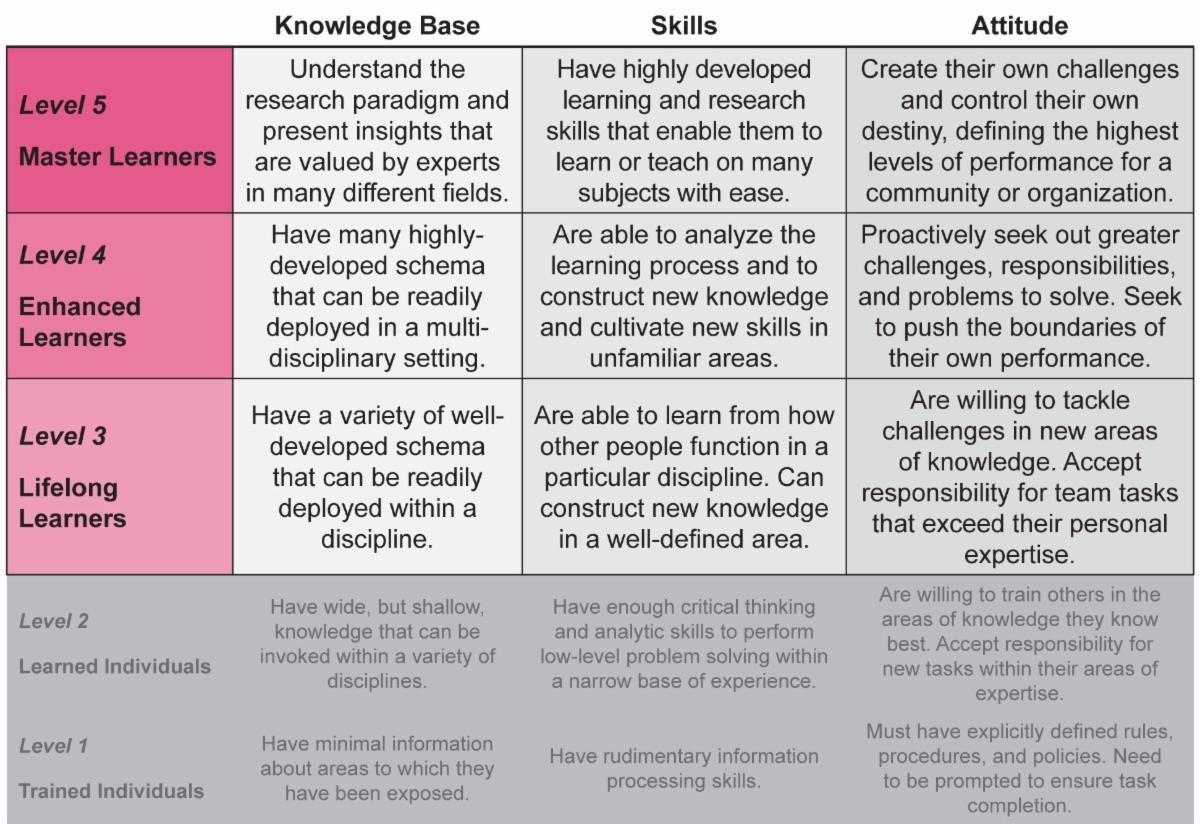
The
Levels of Learner Knowledge
(FGB 2.2.1 Bloom’s Taxonomy—Expanding
its Meaning) gives us a starting point
for either embarking on Step 14 ourselves
(as a learner) or adding it to classroom
curricula for our students’ benefit.
(Because each aspect needs to be geared
towards the individual and the Levels
of Learner Knowledge are not explicitly
tailored for the LPM, the text
in pink
has been added.)
|
|
|
Identifying Features
-
The learner has innovative expertise
which can be used to develop new
understanding
for themselves.
-
Throught the use of lateral thinking,
the learner makes new linkages among
concepts and problem solutions,
which
they
have not
been
seen before
-
The learner knows how to validate
and test their assumptions and hypotheses
to build reliability in the knowledge
structure
-
The learner knows how to communicate
this understanding to others so
it can be
potentially
shared as common knowledge
Key Words
theorize,design,formulate,discover,make
up, hypothesize, prove, disprove, invent,
create an original work
Questions
Can you formulate a theory for...?
Can you think of an original way to
…?
How would you prove...? Disprove...?
Should you accept the hypothesis that...?
How would you estimate the results for...?
How feasible is the plan to...?
Can you create a design to...?
What is necessary to discover…?
Can you predict the outcome if…?
|
|
|
The sample questions are particularly
interesting, as they are both rich in
variety and thought-provoking! Any of
these could form the basis for triggering
students to engage in research-oriented
thinking and in fact,
Watts (2018)
notes that “Research learning can also
occur in class when students seriously
approach the divergent critical thinking
question.”
Beyond using divergent critical thinking
questions, which is probably the most
simple way to begin including aspects
of individually-oriented research in
the classroom,
Watts (2018)
shares that “Long-term research projects
assigned for outside of class can potentially
fulfill this step, especially if the
student is the catalyst for the assignment
and decides on the topic.”
It is important to recognize the element
of individual agency at work here; research
is the end of the LPM but also the beginning
of self-directed learning.
Pacific Crest has added a “Research”
section to the majority of the experiences
in
Learn to Learn for Success
(the 10-year revision of
Learning to Learn: Becoming a Self-Grower).
Students are not required to complete
this section; it is presented as an
additional opportunity available to
students, should they be interested.
In the first several experiences, students
are given the opportunity to investigate
links to outside research that applies
to the current learning experience.
In later experiences, students are tasked
with identifying applicable outside
research themselves. Near the end of
the book and semester, students are
challenged to figure out how to use
the research they identify. Through
this intentional application of the
Research step of the LPM, students become
increasingly familiar with reading and
using both academic and scientific research.
Here are some of the examples of the
Research section from
Learn to Learn for Success:
|
|
-
“Visit wikipedia.com and search
for “problem solving.” Navigate
to the “See also” section at the
bottom of the pages and dig a little
deeper into how and where problem
solving is used in various disciplines.
Alternatively, search for ‘problem
solving ______________’, filling
in the blank with your major or
a career you’re considering.”
-
“Review the learning skills that
are key to communicating successfully
(listed in the reading for this
experience). From that list, select
the single skill that you would
most like to improve. Using your
preferred search engine and your
growing researching skills to identify
at least three ways to improve that
skill. Make note of the source name,
URL, and the tip or strategy for
improving that skill. (Don’t assume
you can simply type in the skill
name and have meaningful results
shown to you! Be prepared to search
for synonyms and similar phrases
and follow footnotes, pertinent
authors or sources, and so forth.)”
-
“Read the article, The Rise of Importance
of Personal Development Education
in Higher Education, available on
the companion website. When you’ve
finished, see what else you can
learn about DYL (Designing Your
Life) courses, both in person and
online.”
-
“Your task is to use your growing
internet research skills to dig
more deeply into the subject of
cognitive behavioral therapy and
investigate its links to self-efficacy
and defusing and using evaluation.”
|
|
|
The point of the research step and learning
how to conduct individual-oriented research
is inextricably bound up with learner
self-development which is the product
of Process Education
(https://pcrest.h5p.com/content/1292058680710253557).
Learner self-development includes the
levels in the table below. The top three
of these,
Lifelong learners,
Enhanced learners,
and
Master learners
are who Dewey (1944) was talking about
when he said,
“As students become master learners
their pursuit of knowledge will transition
from guided discovery to independent
exploration fuelled by self-interest.”
This also explains why curricula designers
should not make a Research section a
required or graded part of a learning
activity; individually oriented research
must
be the result of interest on the learner’s
part, to fill their own gap in knowledge
and for their own benefit. Identifying
those gaps and determining how to benefit
from research can only be done by the
individual learner. The most a designer
or educator can or should do is make
the opportunity and a few tools available.
Put succinctly, this is the step where
the training wheels come off.
|
|
|
Ultimately, Master, Enhanced, and Lifelong
Learners are what we try to help create
as educators…we want our students to
leave our courses developed enough to
continue their learning on their own,
beyond the classroom, and throughout
their lives.
|
|
|
In this way, we understand that Step
14 is not the
end
of learning but the
beginning of learning without needing
formal guidance, explicitly numbered
steps, or carefully designed curricula.
Step 14 is a launch pad for future,
self-directed learning!
|
|
|
Member-Led Practices Take Center Stage
|
|
|
Personal
innovations were on full display at
the mid-November Self-Growth Community
session, where participants shared their
most impactful self-growth practices
developed since the project began in
August. Guided by the theme
"Powerful Participant-Driven Practices:
Detailing, Sharing, and Refining What
Works,"
the session invited each participant
to reflect on 3–4 strategies they’ve
used to foster meaningful personal growth—ranging
from structured reflection routines
to GPT-supported planning and emotional
regulation tools.
Participants highlighted standout practices
with broad appeal, forming a rich and
diverse map of personal growth strategies.
Common themes included aligning daily
actions with core values, cultivating
presence, and deepening self-awareness.
Together, these habits revealed how
intentional routines can transform everyday
experiences into opportunities for learning
and growth.
Crucially, participants didn’t just
share tools—they shared
hope:
the forward momentum generated by seeing
growth unfold, the satisfaction of integrating
wisdom into daily rhythms, and the clarity
of living with more purpose. The session
concluded with a reflective round where
each participant named new practices
they were inspired to try—extending
the value of the session into the days
ahead.
All group insights are now available
on the
Community Moodle site,
creating a shared repository of practical
wisdom from across the cohort. Whether
you're looking to refine your self-reflection
process, experiment with GPT tools,
or reconnect with your growth goals—there’s
something here for everyone.
|
|
Shared Innovations from the November
19 SGC Session
Identity Readiness Checker
Unite mindset, identity, and scheduling
by remembering intentions for needed
presence in the moment, inspiring better
performance and personal growth.
Gratitude Timeout
Invoke a needed pause for deep appreciation,
grounding emotional well-being in the
midst of daily complexity.
Tracking Highs & Lows
Capture emotional patterns through weekly
journaling, leveraging GPT for alignment
with your Horizon Self.
Naturalistic Reflection Timing
Align daily reflection with natural
rhythms (e.g., morning meditation),
increasing consistency and integration.
Growth Goal Analyzer for Work Products
Use a GPT expert to assess how recent
outputs reflect long-term development
goals and generate next steps.
Intermediate Goal Articulation
Connect weekly efforts to mid-range
milestones with the help of GPT summaries,
keeping attention focused and momentum
alive.
Classification of Learning Skills
Reference and use this academically
sound PE taxonomy of 500+ learning skills
to shape meaningful objectives and design
growth-supportive experiences.
Manage GPT Advice
Challenge and filter GPT recommendations
that could otherwise be divergent and
distracting. Be forthright in asking
for alternatives in the AI environment
in order to shift these toward actions
that are more personally acceptable
and satisfying.
Poetry Realization for Celebration
Use GPT co-authorship to create personalized,
milestone-marking poems rooted in one's
narrative and accomplishments.
Analyzing Habits with “Better Offers”
Deconstruct behavioral loops by assessing
motivation, identifying impact, and
replacing them with more virtuous alternatives.
Focus on and Measure Horizon Traits
Build custom performance scales using
GPT to intentionally cultivate specific
personal or professional traits.
Pursue a Wisdom Context Framework
Seek a lens for understanding how wisdom
manifests differently across growth
roles—from performer to guide.
|
|
Self-Growth Tip:
The Paradox of Pacing: Slowing Down
to Speed Up
|
|
|
|
|
In our pursuit of productivity
and growth, we often try to
accelerate, to go faster, push
harder, and look for shortcuts.
But it rarely works out well
in real life. The shortcut on
the map isn’t always a reliable
road. Sometimes it's an old
snowmobile trail that peters
out after about 4 miles (you
can probably guess how I know).
|
|
|
The Cost of Rushing
When
we rush through tasks—whether by design
or distraction—we risk making mistakes
and/or missing everything that needed
to be done, thereby making it necessary
for us to spend more time fixing or
finishing things.
The path
to sustainable growth is paved with
thoughtful pacing. Taking the time to
ensure proper completion and deep engagement
with the current task is not a pause,
but an investment.
Example:
Coding and Debugging
Consider
the process of writing software code.
A programmer who rushes to meet a deadline,
skipping thorough testing or failing
to write clean, well-documented code,
may initially appear faster. However,
this haste results in:
-
A
higher incidence of bugs (defects)
-
Significantly
more time spent in the debugging
phase later on, often hours or days
longer than the time "saved" initially
By contrast,
the developer who practices deliberate
speed reduction—taking the time to design
the architecture correctly, write comprehensive
unit tests, and review their own code
immediately—experiences short-term slowness
that yields a dramatic long-term 'speed
up' in project completion, reliability,
and maintainability.
The Outcome: Productivity and Well-Being
By actively
resisting the urge to hurry and prioritizing
closure and quality in every increment
of work, you are doing more than just
avoiding mistakes. You are...
-
Increasing
Long-Run Productivity: The effort
spent on quality assurance now eliminates
much larger blocks of time spent
on error correction later
-
Cultivating
a Sense of Well-being: Operating
from a place of control and thoroughness
reduces the stress and anxiety associated
with chaotic, unfinished, or faulty
work
The central
growth tip is clear:
Slow down to speed up!
Be deliberate, ensure closure, and watch
your overall efficiency and sense of
well-being grow.
|
|
GPT Development
We
have developed an advanced AI agent
named the
GPT Designer,
used extensively by participants in
the GPT Design Institute. This agent
leverages a curated library of over
140 knowledge files to assist designers
in creating customized GPTs. These resources
support the generation of critical design
artifacts such as EIFs (Expertise Integration
Frameworks), SKFs (Skill-Knowledge Frameworks),
capability files, and include additional
design tools and best practices for
GPT development.
|
|
Self-Growth Project
The
Self-Growth Project currently includes:
-
50 total participants
-
5 certified self-growth coaches
-
1 community facilitator
-
8 researchers
-
35 active self-growers
Now
in
Week 15 of a 26-week journey,
the project has generated significant
learning and advancement in both individual
growth and methodological refinement.
The Role of the Guide has
been elevated through consistent use
of tools like the Weekly Reflector,
Daily Reflector, Truth Seeker, Insight
Generator Pro, and Wisdom Circulator.
These tools have helped participants
generate higher-quality insights from
lived experiences. A typical process
now includes:
-
Capturing a key observation from
an experience.
-
Extracting an insight using structured
reflection.
-
Forming a new intention based on
that insight.
-
Circulating the intention using
the Wisdom Circulator to increase
contextualized wisdom.
-
Identifying
Wisdom Embodiment Practices for
forward action.
The Director Role is
now more deeply integrated into participants'
weekly lives. Insights are increasingly
transformed into intentions, and—with
support from the Decision Maker Coach—used
to frame weekly outcomes and guide the
design of the upcoming week.
|
GPTs for Growth Roles
We
are developing
role-specific GPTs aligned
with our self-growth framework:
-
The Guide GPT:
Elevates insightfulness.
-
The Director GPT:
Strengthens intentionality.
-
The Coach GPT (in
development): Builds inner strength
through active growth planning.
Each
GPT incorporates role-relevant knowledge,
performance criteria, reflection models,
and best practices, expanding the impact
and autonomy of each internal growth
role.
The
Coach Role,
specifically, is being prototyped as
the
Active Growth Coach GPT,
which designs actionable weekly growth
plans aligned with each participant’s
evolving intentions. It integrates:
-
The 13 aspects of inner strength
-
The 8 competing internal voices
-
A framework that supports strengthening
the Horizon Self’s voice through
targeted focus on key strengths
and dampening of dissonant voices
|
Publications and Thought Leadership
The
Self-Growth Project is generating a
series of research papers and theoretical
contributions, currently under development:
-
Wisdom by Design
-
The Role of GPTs in the Self-Growth
Journey
-
The Impact of Self-Growth Coaching
on Capability Development
-
The Role of Community in Self-Growth
-
Learning Outcomes in AI-Augmented
Education
-
Theoretical Framework for the Self-Growth
Journey
-
The Developmental Process of Inner
Strength
|
|
Book Rewrite – Becoming Your Best in
168 Hours
We
have made substantial progress in the
rewrite of
Becoming Your Best in 168 Hours,
in collaboration with Rick Stone and
Quillium Studio. This includes:
-
30 pages of new, more engaging content
-
A refined and resonant
Table of Contents
-
A clearer writing style aligned
with our narrative tone and reader
connection strategy
|
|
News and an "Old" You Maybe Didn't Know
|
|
|
We support assistive technology and
inclusivity!
A few
weeks ago, a university accessibility
coordinator reached out about an accessible
version of
Foundations of Biochemistry
for students who use assistive technology.
We were happy to meet the need with
a file that can be zoomed up to 400%
and read aloud using text-to-speech
tools. It made use stop and think about
how much these features can open up
learning for students with different
needs. Many of our
Process Education
exercises already encourage teamwork
and shared problem-solving, which helps
make the classroom experience more inclusive
for everyone.
Microlearning
This
academic article
Next-Gen Education: Enhancing AI for
Microlearning
explores how microlearning — short,
modular lessons with interactive elements
— combined with AI tools is transforming
the way educators design and deliver
courses. It’s interesting to see how
institutions are evolving to meet students
where they are, whether that means accounting
for shorter attention spans, remote
and hybrid learning, or the growing
role of AI.
We've
been believers in this for a long time
now! While our
Faculty Guidebook
clocks in at an impressive 583 pages
of content, it is organized in 2- or
4-page modules, each one of which is
a self-contained chunk of useful and
thought-provoking scholarship. This
same organization is available in the
e-Faculty Guidebook,
accessible through any web browser.
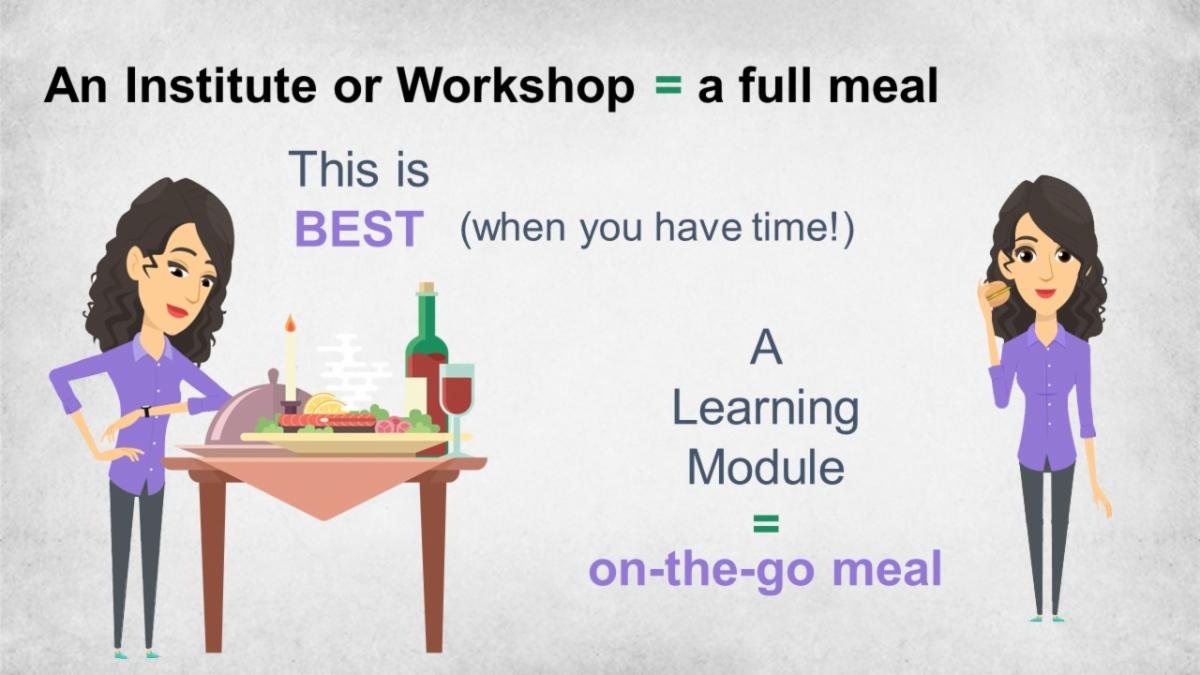
Beyond
the FGB, we also offer stand-alone
Learning Modules.
At just $10 each, these interactive
micro-courses include video, quizzes,
printable take-aways, and humor, all
within a professionally designed learning
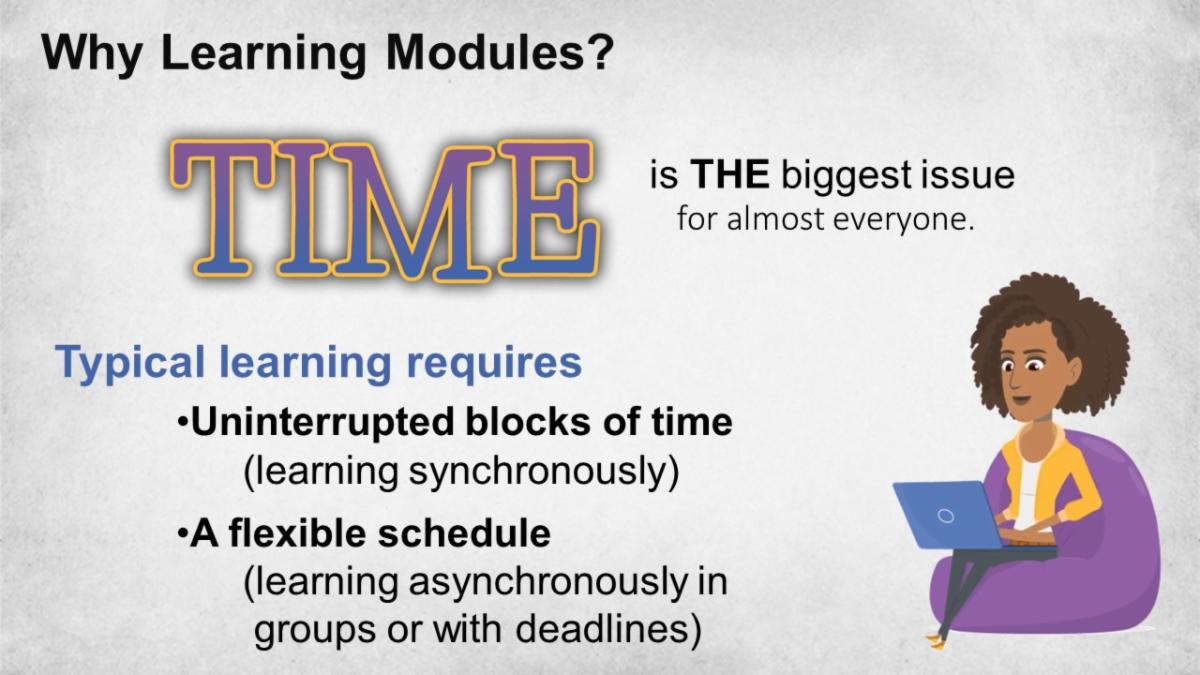
environment. As we pointed out years
ago:
|
|
|
Our Learning Modules offer the BEST
of Learning How to Learn on YOUR terms
and at YOUR pace. Modules currently
available:
|
|
|
Keeping an Eye on Higher Education
|
|
|
| | |