|
|
|
REFLECTIONS
Monthly News & Updates
|
|
|
|
Insider Perspectives from Three Participants
At the Institute, three members of the
University of Indianapolis community
participated in the fully online experience.
They were: Julie Gahimer, Christine
Kroll, and Josh Morrison. This is their
account of their experience.
|
|
|
The “A.I. Era” has certainly arrived!
With the release of OpenAI’s ChatGPT
a few years ago, to innovations from
Google (Gemini), Claude (Anthropic),
Deepseek, Perplexity, and many others,
access to generative artificial intelligence
services is nearly ubiquitous and almost
unavoidable.
The power of these systems is quite
high and undeniable. Even so, their
usefulness
to humans and humanity remains an open
question. For the group that attended
Pacific Crest’s Generative AI Development
Institute on October 12-14, the question
of usefulness has been well answered.
Yes, GPTs are indeed powerful, useful,
and are increasingly becoming essential
tools to accelerate progress in learning,
organizational development, and in many
other areas.
During the first day, participants were
guided through a process to assess the
functions and behaviors of existing
Pacific Crest custom GPTs. These GPTs
have been developed using very robust
design practices, ensuring that they
behave within their guidelines and reference
appropriate resources. They served as
strong models for future development
on days two and three.
On the second day, participants began
hands-on design work, following a set
methodology to carefully determine the
purpose, functions, and subfunctions
of a custom GPT. This included developing
explicit External Information Files,
Knowledge Files, Capability Files, and
a new file type - the Persona File.
Each of these file types includes set
protocols, functions, and formatting
to make the GPT act as a highly capable
partner in solving problems in its intended
area. By the end of day two, each of
us had a working prototype GPT, or more
than one, that was created using the
Pacific Crest methodology.
On our last day together, participants
revised and trained their GPTs, ensuring
fidelity to the External Information
File and other files, to make the performance
of their tools even more impactful.
We utilized a two-person team-based
approach both on Monday and Tuesday,
resulting in enhanced GPTs that leveraged
the ideas and feedback from our teammate.
During the Institute, Josh focused on
developing Google Gems through Gemini,
Google’s AI system. He created a GPT
for nonprofit organization strategy
called The Strategist, a GPT to assist
in academic literature reviews entitled
the Lit Review Pro, and developed the
Program Assessment Guide, a tool to
assist academic programs in improving
student outcomes and organizational
performance. A key learning for Josh
was the crucial role of a clear purpose
and set of well-defined and discrete
functions. Throughout the Institute,
the value of determining a fairly narrow
purpose [use case] for the GPT was reinforced
regularly. Clarity on the functions
needed and the processes the GPT will
follow are both essential to designing
a high-quality GPT.
Christine chose to develop a coach to
assist the occupational therapy doctoral
students throughout their capstone courses
and during the experiential placement. The
result is a custom GPT called Capstone
Planning Coach that will provide coaching,
prompt critical thinking, and offer
problem-solving guidance during this
self-directed placement and project.
Through the institute, Christine realized
that this could also be easily used
to assist any student or discipline
working on a capstone. The intent is
not to replace mentors; rather, it is
to provide in-the-moment coaching for
the student.
Julie embarked on designing the “Quality
of Life (QoL) Coach” GPT. It is a holistic
wellness coach enhanced by quality-of-life
research and evidence-based insights.
It is intended for first-year students
in the Doctor of Physical Therapy (DPT)
Program at the Krannert School of Physical
Therapy enrolled in a Health Promotion
course. It will support students in
achieving comprehensive well-being through
structured coaching sessions, visual
tools, reflective inquiry, and an expanded
set of evidence-based interventions.
The QoL Coach emphasizes the balance
between personal satisfaction and measurable
wellness outcomes. It acknowledges how
social determinants, environmental design,
autonomy, and meaning interact to shape
life quality. The coach uses these insights
to help students 1) develop a personalized
“QoL Index” based on subjective ratings
and objective habits, 2) explore their
alignment between values, lifestyle,
and satisfaction, and 3) devise interventions
that support “flourishing”, just not
functioning—focusing on meaning, connectedness,
and vitality. During the institute,
she learned from other participants: best
practices, insights, challenges, and
plans for future development. Peer feedback
and facilitator personal coaching were
the highlights of the 3-day experience.
All UIndy participants are grateful
for the opportunity to participate in
this first instance of the AI GPT Development
Institute. We benefit from the University’s
Google partnership, which allows us
access to NotebookLM, as well as Google
Gemini. NotebookLM is a GPT allowing
users to create custom notebooks that
develop study aids such as podcasts,
mind maps, and others, while Google
Gemini is a GPT service similar to ChatGPT.
|
|
|
Episode 4
Grading Doesn’t Teach Students How to
Improve
(FREE!)
|
|
|
This episode kicks off with the amusing
revelation that Pablo Picasso, in his
later years, sometimes required supervision
in galleries because he had been caught
trying to "touch up his own paintings"—a
perfect, if eccentric, example of the
"constant human drive we have to make
things better". This impulse to refine,
even our best work, serves as the springboard
for a deep dive into the crucial distinction
between
evaluation
and
assessment.
We explore why relying solely on evaluation,
which delivers a judgment or grade right
at the end and often lacks the necessary
roadmap, risks getting students stuck
in a cycle of repeated attempts hoping
for a different outcome. Crucially aimed
at educators trained primarily as evaluators,
the episode details the shift required
to adopt the assessment mindset, which
involves focusing only on the performance
characteristics—not the person—and valuing
the assessee’s goals first. We define
the MEA (measurement, evaluation, assessment)
framework and then tackle the "final
frontier" for self-improvement:
self-assessment,
arguing that it is exponentially harder
because we instinctively evaluate ourselves
rather than objectively assessing the
work. Tune in to learn why the ultimate
goal is consciously becoming your own
mentor, not your own judge, complete
with a structured roadmap for setting
genuinely important criteria (like sophistication
of argument, rather than just word count)
and developing both short-term and long-term
action plans for sustainable growth.
|
|
Based on
Faculty Guidebook
modules focused on Evaluation and Assessment,
as well as
Learn to Learn for Success.
Created with the help of Notebook LM.
|
|
Ongoing Series:
The Learning
Process Methodology
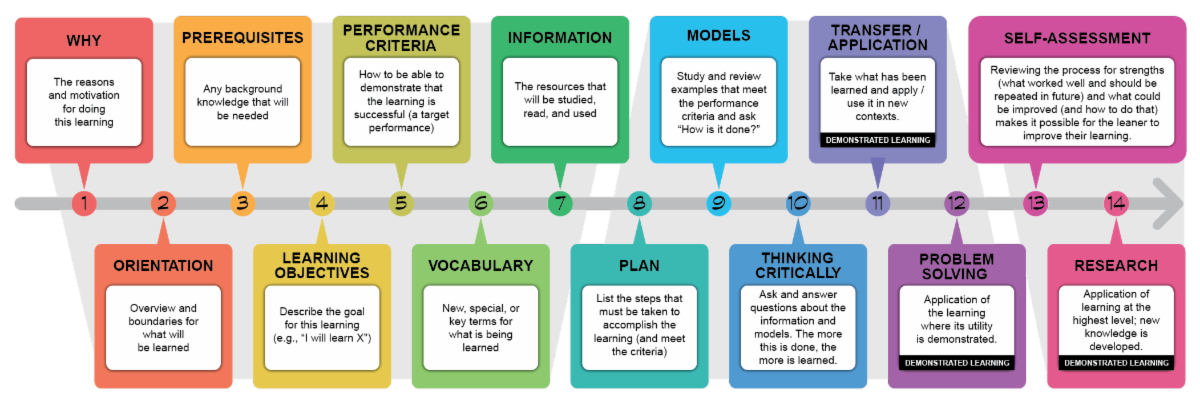
How to Learn in 14 Steps
|
|
|
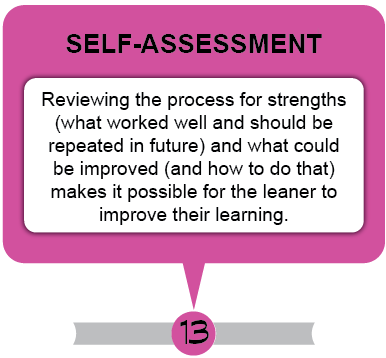
The thirteenth step of the LPM:
Self-Assessment
When you've learned something, how do
you
know
you know it?
|
|
|
|
The
Faculty Guidebook
module Learning Process Methodology
notes that this step is most essentially
about the “Self-Assessment of Growth”
and involves documenting improvements
in “knowing you know” (FGB 2.3.8).
The authors share the observation that
Transfer/Application (Step 11) and Problem
Solving (Step 12) both involve challenges
that demonstrate this kind of growth.
This means that in order for a learner
to accurately assess their performance
in
learning,
they need to look most closely at the
result of that learning:
transferring/applying what they learned
and using what they’ve learned to solve
problems. Being able to do those two
things indicates successful learning
(and successful application of the Learning
Process Methodology).
In Self-Validation of One’s Learning
(FGB 3.3.5), Rick Armstrong tells us
that,
|
|
Too often, there is a large gap between
what students think they know or understand
and what they have actually learned.
Self-validation is a multi-faceted skill
set that allows students to change their
mindset from “thinking they know” to
“knowing they know.” By cultivating
and using an array of validation skills,
students will legitimately “own” their
learning.
|
|
The validation skills that Armstrong
shares include the kinds of application
of learning we’ve already covered in
Steps 11 and 12, but adds
Teach others
as in intriguing additional method of
validating learning.
While this is not explicitly part of
the LPM, it probably should be! Certainly,
we all know that the best way to learn
something is to be in the situation
of needing to teach it to someone else.
As educators and learning activity designers,
we need to keep this method of validating
learning in mind and, when possible,
task students (and ourselves!) with
teaching as a way to “know we know”
or "show we know".
Coming at this step from a slightly
different direction, while Watts defines
it similarly to the definition above
(Assessing use of the learning process
and mastery of the material learned),
they continue, focusing on earlier steps
in the LPM:
|
|
“Having finished the learning performance,
the mastery of the learning objectives
and fulfilling of the performance criteria
can be assessed. Self-Assessment has
the learner give themselves feedback
on the performance with a growth mindset,
i.e., the intention of improving future
performances. This should be done in
the form of a positive attitude that
avoids harsh self-judgement.“
(from
The Learning Process Methodology: A
Universal Model of the Learning Process
and Activity Design)
|
|
This answers the question, then, of
what criteria to use when performing
an assessment of learning.
While application and problem solving
are the best examples of that learning
in practice (and thus the best performance
demonstrating that learning), the assessment
should be conducted according to whether/how
the learner met the learning objectives
(Step 4) and to what degree their performance
in applying their learning by solving
problems meets the performance criteria
(Step 5).
That’s it!
The optimal self-assessment of learning
is to assess the use of application
and problem solving (Steps 11 &
12) of what was (hopefully) learned
(Step 4), according to a set of pre-determined
criteria (Step 5).
What’s most critical is that all these
pieces/steps are
in alignment.
Identifying learning objectives (the
goal for learning: Step 4) that end
up being very different from what we
ultimately learn is a bit like booking
a trip to Paris, France, but ending
up in Paris, Texas. Both may be nice
places, but we didn’t reach our intended
destination. For teachers and activity
designers, that’s a major uh-oh. The
same goes for the performance criteria
we set for what we would learn…if the
performance that best demonstrates that
learning occurred differs much from
what we end up doing in applying or
using that learning to solve problems,
we’ve left the map we initially created.
You can argue that what you ended up
learning was still worthwhile, but the
point is that the learning objectives
and/or performance criteria are no longer
available to guide assessment of learning.
If the point of a self-assessment of
learning is to IMPROVE learning, the
improvement is only possible if the
assessment is valid.
Think of it this way:
A self-assessment without criteria or
a clear performance
is basically just a certificate
of participation.
You did something but its value to your
growth is questionable.
As Armstrong puts it,
|
|
|
“Students need to be encouraged to self-assess
their performance and identify ways
they can improve. Self-assessment should
be done in a meaningful and interesting
way, consistent with the learning objectives
and success criteria.”
|
|
|
And on that note of encouraging students
with respect to self-assessment, we
find the criteria for including self-assessment
as a part of any learning activity in
the
Activity Design Institute Handbook.
It recommends that when we task students
with assessing their learning, we ensure
that:
-
The assessment we ask them to perform
is
timely
(in relation to what they’re currently
doing and the information they currently
have)
-
There is the
opportunity for improvement
as a result of the assessment (there’s
no point in assessing a one-off
performance!)
-
The assessment is
properly scoped
(think Goldilocks: it shouldn’t
be too narrow or too broad)
-
It is aligned with the
performance criteria
we should have already shared with
them and
-
The assessment itself is
sequenced appropriately
as part of a larger context that
is devoted to development.
|
|
Assessing the
Guide Role
in the Growth Cycle
|
|
Here's a little background on
the Role of the Guide...skip
this if you already know!
The Guide helps the individual
take time out to effectively
reflect and ponder on key moments
and develop significant insights
to determine how meaningful
each moment was. They will use
these explorations to help clarify
who the individual is and what
life qualities they value in
a caring, nonjudgmental manner.
To create greater meaning, the
Guide will compassionately consider
the high and low moments in
life as well as reflect with
gratitude on the many positive
aspects of their life. They
will use this meaning to help
determine who they wants to
become by defining their ideal
self. This increased metacognition
allows the Guide to act as an
inner compass to guide and ensure
that actions, decisions, and
behaviors align with personal
values, intentions, and efforts
to develop the ideal self. While
the Guide must use skills in
the cognitive domain, all other
domains must also be leveraged
or aspects that connect the
whole being will be missed while
trying to enhance their ongoing
life journey and quality of
life. Being open to insight
and elevated meaning can help
the individual explore ways
that differ from their usual
expectations and intentions.
New meaning gained in this way
often causes necessary refinement
of the ideal self and how the
individual wants to share their
journey with others, especially
those most important. Ongoing
weekly reflection helps the
Guide to empower the individual
so they can correct actions
and behaviors that are inconsistent
with their ideal self, especially
when that ideal self continues
to change and evolve.
|
|
|
|
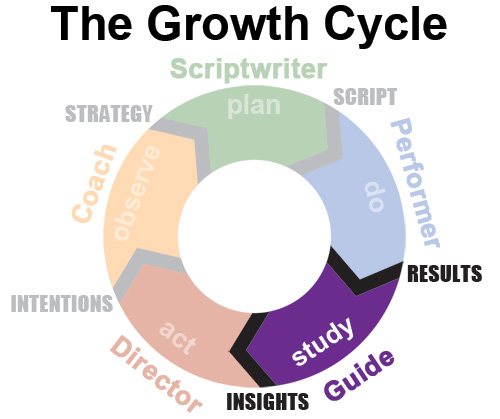
The Self-Growth Community has entered
a new phase in its research by exploring
how to assess and strengthen the five
key roles in the Growth Cycle—Guide,
Director, Coach, Scriptwriter, and Performer
(read
about those roles here).
At the October 15 community session,
Cy Leise led a discussion on the value
and challenge of empirical approaches
in a process as subjective and personal
as self-growth.
|
|
|
|
Participants
explored whether and how internal growth
processes could be measured meaningfully—especially
when driven by reflection, values, and
intentionality.
A centerpiece of the discussion was
an early draft of the
Guide Role Tool,
which aimed to assess confidence in
enacting
meta-behaviors—
situational mindsets and responses that
shape how we reflect, interpret, and
grow from experience. Participants examined
the clarity of tool items, their relevance
to real growth situations, and their
potential to inspire deeper self-assessment.
Feedback emphasized the need for greater
personal relevance, clearer developmental
language, and a rating system better
aligned with reflection rather than
static self-confidence.
Based on the session’s feedback, Cy’s
team created a
second-generation version
of the tool. This version broadened
the tool from 10 to 12 distinct meta-behaviors,
each framed not just as a cognitive
skill but as a
lived mindset shift.
To make the tool more usable in real-life
coaching and reflection, each meta-behavior
now includes:
-
A
short, relatable name
(e.g., “Notice What’s Happening,”
“Tune into Feelings”)
-
A clear definition of
what the behavior means
-
An explanation of
why it matters
in a growth context
-
A
“From
→ To”
developmental shift that describes
how the behavior evolves with use
-
A revised
meta-behavior statement
capturing its deeper purpose in
self-growth
This version also reflects a shift from
generic self-assessment toward situation-based
reflection. Users are asked to identify
a specific growth challenge and rate
each meta-behavior based on both its
relevance to the situation and its potential
impact on success. This dual-rating
system helps uncover blind spots and
guides more personalized growth planning.
Here are the first 3 meta-behaviors
expanded:
|
|
|
1. Noticing What’s Happening
What It Means
Pay attention to your thoughts, emotions,
and environment without judging or avoiding
them.
Why It Matters
Builds self-awareness and helps you
catch small cues that can grow into
insights or patterns.
From → To
From overlooking inner signals → to
noticing patterns that reveal meaning
and inform growth.
Meta-Behavior
You stay present and observant, noticing
thoughts, feelings, and shifts without
judgment—tuning into signals that guide
growth before they escalate into problems.
|
|
2. Reading the Situation
What It Means
Recognize how context—people, place,
timing, roles—shapes what’s happening
and what’s possible.
Why It Matters
Enables you to act with greater wisdom
by aligning with what the moment calls
for.
From → To
From reacting the same way everywhere
→ to adapting thoughtfully to the unique
demands of each situation.
Meta-Behavior
You attune to the moment—reading dynamics,
timing, and roles—to respond in ways
that fit and elevate the context you’re
in.
|
|
3. Tuning Into Feelings
What It Means
Notice emotional and energetic signals—your
own and others’—as valuable sources
of information.
Why It Matters
Emotions reveal needs, tensions, and
truths that logic alone can’t access.
From → To
From ignoring or misreading emotions
→ to using emotional cues to guide wiser
action.
Meta-Behavior
You sense the emotional tone within
and around you, letting feelings inform
understanding, connection, and right
timing for your next move.
|
|
|
The remaining 9 meta-behaviors of the
Guide are:
|
|
|
4. See Other Views
5. Look Back for Clues
6. Spot the Insight
7. Listen to Your Inner Voices
8. Be Real with Yourself
9. Write Your Story
10. Be Kind to Yourself
11. Trust Yourself
12. Name the Gap
|
|
|
This updated tool will be field-tested
in November coaching sessions and is
intended to lay groundwork for similar
tools for the other four roles.
Community members interested in piloting
the tool or offering feedback are invited
to
reach out to Cy’s research team.
|
|
Self-Growth Tip:
Choosing Your Battles Wisely
|
|
|
Self-
growth requires understanding where
to focus our energy. One of the most
powerful skills we can cultivate is
knowing when to engage and, more importantly,
when to let things go.
|
|
|
|
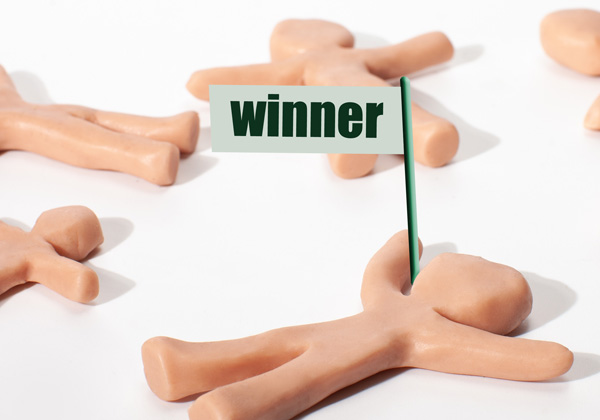
Every conflict, disagreement, or "battle"
in life, whether at work, with family,
or with a stranger, comes at a price.
We can easily spend significant resources
and strain others’ goodwill and our
relationships. Before diving in, we
need to stop and ask ourselves:
Is the potential win truly worth the
cost?
Because sometimes, even a "win" can
be a devastating loss: a pyrrhic victory.
That’s when winning costs so much that
might as well be defeat.
In our personal lives, a pyrrhic victory
might look like "winning" an argument
by tearing down a relationship, or achieving
a short-term goal by completely sacrificing
our peace of mind or health.
For a battle to be worthwhile, the "return"
must be so overwhelmingly positive that
it justifies all the resulting fallout
and energy expended. Many interpersonal
battles don't meet this standard—too
often, there are no real winners.
Greater peace (and self-growth) come
by choosing to move on and let the issue
go. This is especially important when
the problem is someone else's behavior.
We truly cannot control others and trying
to force them to change is a recipe
for frustration (ours and theirs) with
a side order of wasted energy.
Better to engage in issues of real significance:
our growth, values, health, and most
vital relationships.
|
|
|
Keeping an Eye on Higher Education
|
|
|
|
There
are many stories and trends that we're
keeping an eye on. We're happy to share
these, along with links to learn more.
|
|
Recent college graduates in the U.S.
are having a tougher time finding
jobs than usual
The unemployment rate for U.S. degree-holders
ages 22–27 reached 5.8%
in March 2025, which is higher than
the overall unemployment rate and the
highest in more than a decade excluding
pandemic years. Entry-level job postings
(and internships) for new grads are
down significantly — for example, postings
on the platform Handshake were down
~15% between July 2024 and April 2025
compared to the prior year.
“New U.S. college graduates enter a
‘freezing’ labour market” (Financial
Times) — a detailed look at hiring declines
for new grads. https://www.ft.com/content/87a393a2-0b5d-4a20-bee5-7f9484dbd870
Many institutions are seeing public
skepticism about whether college
degrees justify the cost. If potential
students question the value of higher
education, enrollment drops, which further
exacerbates financial strain. It becomes
a feedback loop: declining enrollment
→ fewer revenues → cuts or closures
→ weaker programs → less appeal.
Colleges are fighting to prove their
return on investment (AP)
https://apnews.com/article/college-degree-cost-tuition-return-on-investment-31a538551062e4632c6d76a999e9c87e
|
|
|
Federal
Influence & Academic Freedom
|
|
|
The White House introduced a “Compact
for Academic Excellence in Higher Education”
which would tie federal funding for
universities to compliance with certain
policies around DEI (diversity,
equity, inclusion), gender rules, and
international student oversight.
In exchange for funding, schools would
have to report more data and
potentially adjust campus policies to
meet new federal standards.
Brown University, Harvard, Stanford,
and several state systems have declined
to sign or have publicly criticized the
compact. They argue it threatens academic
freedom, institutional autonomy, and
free inquiry by letting the federal
government dictate campus policy and
research priorities.
American Association of Colleges and
Universities (AAC&U) Statement on
the Trump Administration’s “Compact
for Academic Excellence in Higher Education”
In April, leaders of America’s colleges,
universities, and scholarly societies
called for constructive engagement
with government in response to unprecedented
overreach and political interference
in higher education—expressing openness
to constructive reform and acceptance
of legitimate government oversight,
while also affirming the core principles,
shared values, and established legal
framework on which the American system
of higher education rests.
Regrettably, the administration has
continued to seek ways to impose its
own ideologically driven vision for
higher education through unilateral
executive action and the coercive use
of public funding. On October 1, it
invited a first cohort of university
leaders to sign a “compact” that would
commit their institutions to the vigorous
pursuit of the administration’s priorities.
The compact is, in effect, an ultimatum:
sign and receive “multiple positive
benefits,” including “substantial and
meaningful federal grants,” or retain
the freedom to “develop models and values
other than those” of the administration,
and “forgo federal funding.”
This is not constructive engagement.
Continue reading…
https://www.aacu.org/newsroom/aac-u-statement-on-the-trump-administrations-compact-for-academic-excellence-in-higher-education
Stanford Daily: From the Community |
We must refuse the ‘Compact for Academic
Excellence in Higher Education’
The Trump administration’s new “Compact
for Academic Excellence in Higher Education”
is a trap.
Presented last week to a group of nine
universities that doesn’t yet include
Stanford, the compact proposes a list
of policy changes the administration
hopes universities will agree to in
exchange for preferential access to
federal grants. Several of the proposed
reforms respond to legitimate concerns
about higher education and identify
real challenges that elite universities
have faced in recent years. As White
House advisor May Mailman
put
it, “Our hope is that a lot of schools
see that this is highly reasonable.”
However, if you are debating whether
the Trump administration’s proposed
changes to university policies are reasonable
or not, you are missing the point entirely.
The compact is a thinly veiled invitation
for universities to relinquish their
self-governance and replace it with
federal oversight, a threat concealed
in a Trojan Horse of concerns about
rising tuition costs,
equality
and diversity of ideas. Its effects,
should the compact be adopted, will
not be limited to implementing an enumerated
set of reforms. Whatever your view on
the merits of the proposals contained
in the document, the compact will not
be applied in good faith and will instead
be enforced selectively to coerce university
action on other core matters.
Continue reading…
https://stanforddaily.com/2025/10/12/from-the-community-we-must-refuse-the-compact-for-academic-excellence-in-higher-education/
|
|
|
|
|
FREE WEBINAR SERIES from
The Chronicle of Higher Education
Trump and Higher Ed: Understanding the
Latest
|
|
|
Colleges
nationwide are navigating an unpredictable
landscape as the fall semester kicks
into gear. Our free webinar series breaks
down how the Trump administration is
trying to reshape higher education,
and what shifting federal policies mean
for institutions today.
Sign up for free today and
you’ll automatically be registered for
all fall sessions, taking place once
a month in October, November, and December.
(The September session has already been
held.)
Sarah
Brown, The
Chronicle’s
news editor, and Rick Seltzer, author
of the subscriber-only Daily Briefing
newsletter, will tackle the most pressing
issues in higher-ed policy, helping
you stay informed and prepared for what’s
ahead.
-
Session 3: November
20 at 1 p.m. ET / 10 a.m. PT
-
Session 4: December
15 at 1 p.m. ET / 10 a.m. PT
Don’t
worry if you can’t attend live: Registrants
will receive reminders before each session
and on-demand access to the recordings
afterward.
|
|
| | |