|
|
|
REFLECTIONS
Monthly News & Updates
| |
| |
|
This month's columns include:
- Teaching Error Analysis and Troubleshooting
- A New Team Role: Research and AI Tech
-
AI Transformation Method Black Belt Training Program ($2,100 discount!)
- What's My Motivation?
- Monthly Self-Growth Tip: How Growth Goals Work
- Contextualizing Learning Skills
| | |
Not
only do we make mistakes when we learn, but our mistakes can be the
source of our greatest learning. The trick is figuring out WHY and HOW
we made a specific mistake. | |
|
|
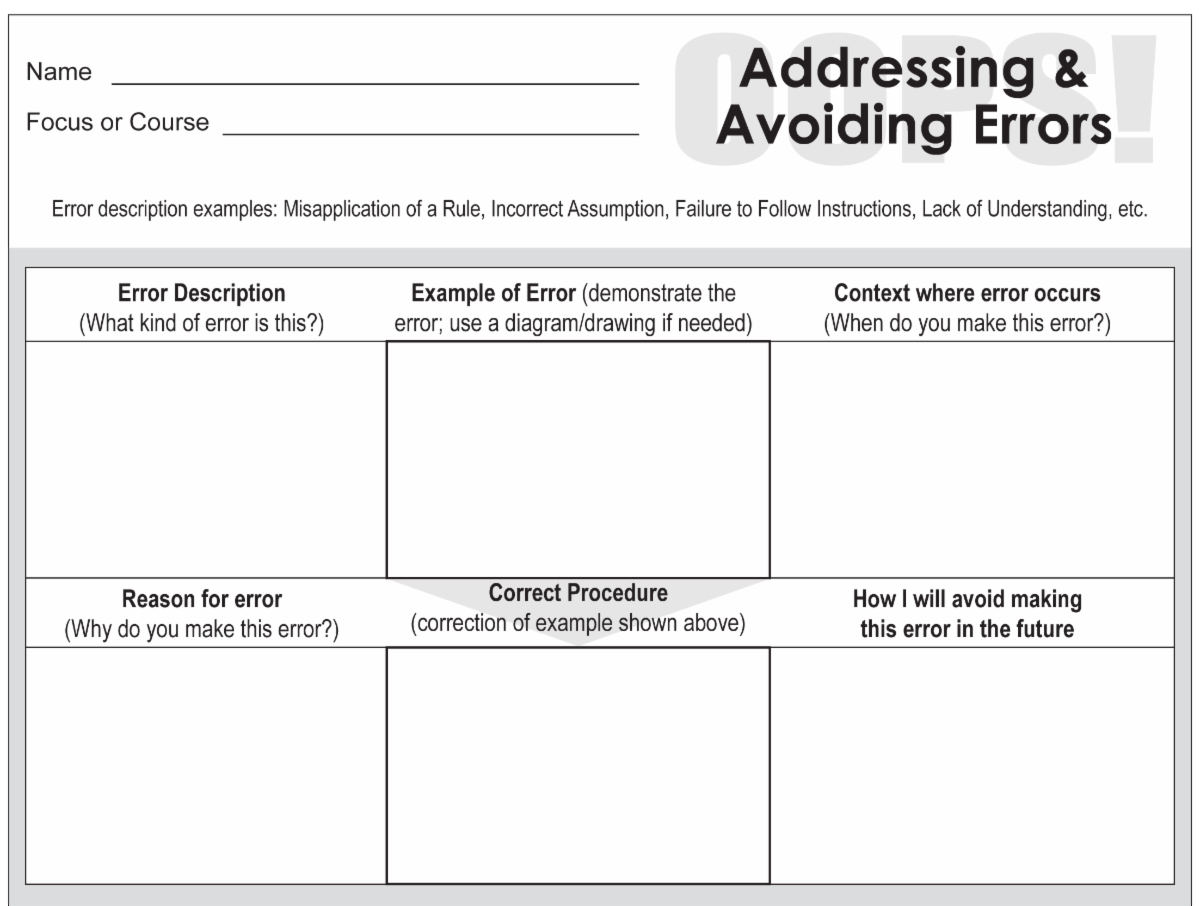
In the Student Success Toolbox, we offer the OOPS! form: Addressing and Avoiding Errors (an excerpt of this form is shown below).
The
steps in this form guide a user through a relatively complex
metacognitive bit of reasoning from identifying the error to determining
where the error tends to occur, through to not only correction of the
specific error, but thinking ahead and planning for how to avoid making
the same kind of error in future.
One
of the real strengths of this process is that it is student-driven and
therefore still guided discovery learning with the learner in charge.
While we initially created this form for use specifically for students
lower division courses, there really is no limit to where and how it can
be used both within and outside of any classroom!
| |
|
It can be ordered as a
digital download for $8.00
| |
or in print for $15.75 per copy (available to bookstores for less) | |
Adoption of the print version includes semester-long access to a companion website for instructor and students that includes everything shown here (not quite "and the kitchen sink" but close!). |
| |
|
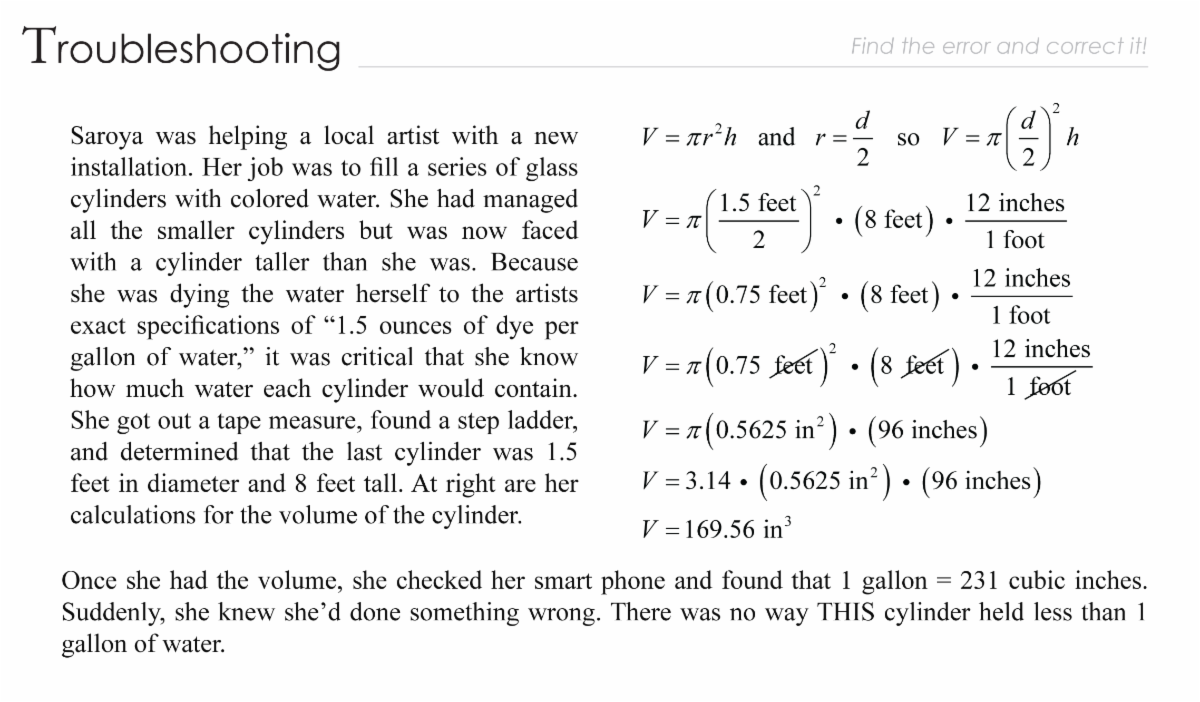
Stepping beyond error analysis, at a higher level of learning and much more puzzle-like, is our innovation to include a Troubleshooting section for each activity in Quantitative Reasoning and Problem Solving.
This
feature offers students an observer’s view of a problem solved by a
fictional student (see the example below). This is a small instance of
problem-based learning and asks the student to bring all they’ve learned
to the table in an effort to first identify the error and then to go on
to solve it. We did all we could to make the scenarios realistic (real
world problems!) and to script errors that are typical of the errors
students make, given the focus of each activity. This gives student a
real challenge and wonderful opportunity to build their problem solving
skills.
| |
|
We
heartily recommend incorporating troubleshooting as an approach to
problem solving and would be remiss if we didn’t point out that adoption
of the Student Success Toolbox includes access to the following:
- Rubric for Problem Solving
-
Problem Solving Methodology (and example)
-
Applying the Problem Solving Methodology (form)
-
Addressing & Avoiding Errors (form)
- Profile of a Strong Problem Solver
-
Learning Skills for Problem Solving (list)
-
Concept Map (blank form with prompts)
| | |
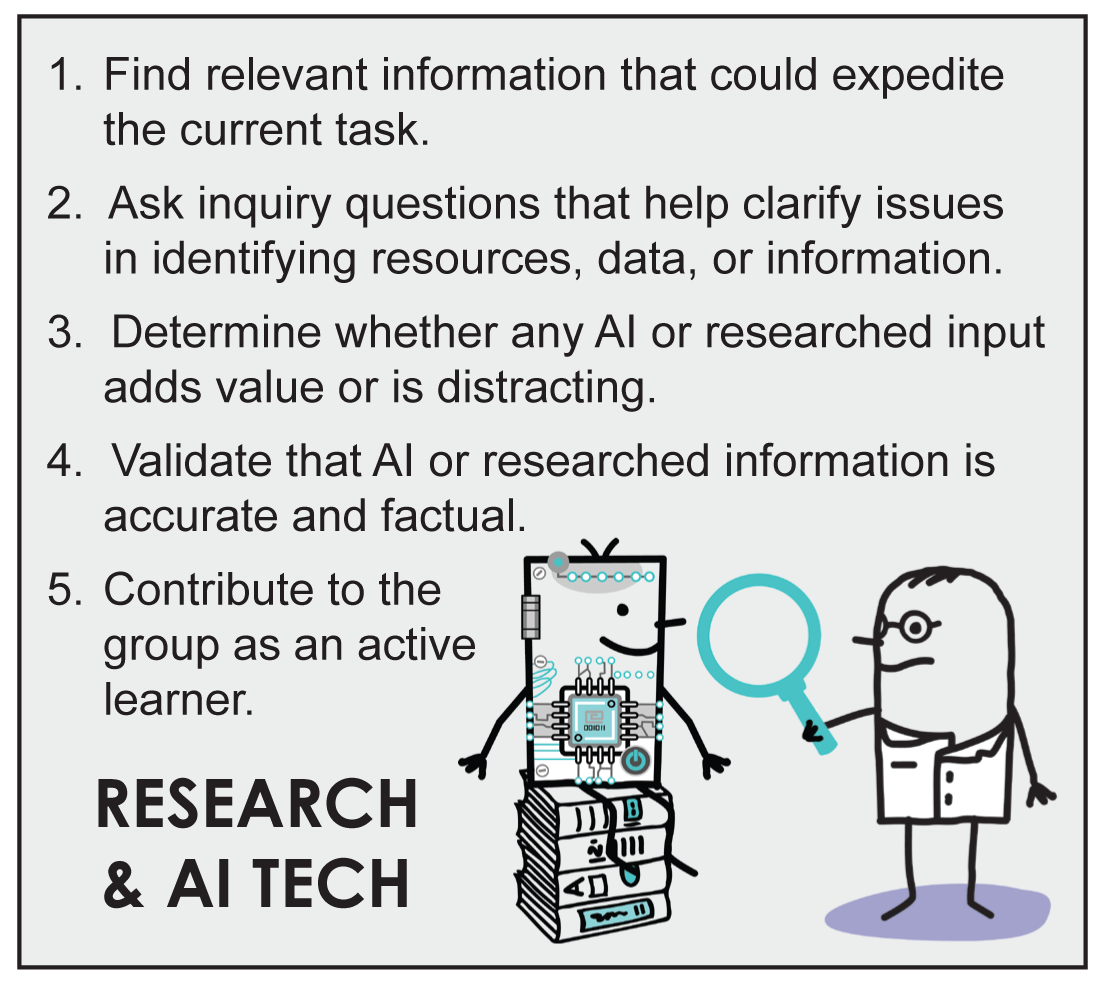
As
Artificial Intelligence (AI) is increasingly finding its place in
college and university classrooms (not to mention the workplace!), we
have added a cooperative learning team role: Research & AI Tech. Here is that role card, including its performance criteria. | |
|
Speaking of AI, we have been authorized to share a very special offer: $2,100 off the AI Mastery Course “AI Transformation Method™ Black Belt” training Program
from Leading with AI.
Course Start: October 2, 2024 at 6:00-7:30 p.m. ET.
Course Delivery: Nine, 1.5-hour weekly live Zoom calls and Q&A.
Enroll now and pay only $400 (instead of $2,500!).
Discount code: AIBLACKBELTPCREST
| |
|
Schedule:
Week 1: Grey Belt - Introduction to the AI Transformation Method™ Black Belt
Week 2: White Belt - Getting Comfortable With The Base Model Tools
Week 3: Yellow Belt - Using AI In Your Role
Week 4: Orange Belt - Using AI As A Cognitive Super Assistant
Week 5: Green Belt - Building AI Assistants
Week 6: Blue Belt - Building 100X Tools
Week 7: Purple Belt - Exploring The Future of Your Role
Week 8: Brown Belt - Working With AI Agents
Week 9: Black Belt - Automation and API
Course Highlights
-
Modular and Gamified Learning: Progress through levels from White Belt to Black Belt.
-
Expert-Led Sessions: Nine 1.5-hour weekly live Zoom classes and interactive Q&A.
-
Flexible Learning: Can't make the scheduled class? Access recorded sessions anytime, anywhere.
-
Personalized Approach: Tailor the course to your specific role and industry.
Course Benefits (Real World Benefits)
-
Immediate Impact: Implement AI strategies that can boost your ROI by 10X, 100X, or even 1,000X.
-
Certification: Earn an AI Transformation Method™ Black Belt to validate your knowledge, skills, and abilities.
-
Increased Efficiency: Discover how to save time and effort with AI-enhanced workflows.
-
Leadership: Learn to design and lead AI strategies within your organization.
-
Networking: Connect with industry professionals and experts.
| | |
|
This is the
stereotypical phrase that the would-be actor asks the director in order
to breathe life into the character. What motivates this character? What
makes them tick? What matters to them? If an actor knows what motivates a
character, they can deduce that character’s values and act accordingly.
“What’s MY motivation?”
is a question we ask ourselves all too infrequently. Our values and
passions are among our strongest and most lasting motivators, but few
people, if asked, can easily articulate what their most important values
and passions are.
There are three general types of motives a person can have: biological, social, and personal.
Biological motives
have to do with keeping the body in homeostasis (balance); we fix
thirst by drinking, hunger with eating, and so on. Our bodies breathe
because they require oxygen. Biological motives generally don’t require
our attention unless we are unable to achieve homeostasis, such as if
we’re starving or overeating, both of which indicate a lack of balance.
Social motives
are those centered in or held by a group. The easiest way to find out
the motives of a society or social group are to look at its rules or
laws. The DOs and DON’Ts of a social group tell us what matters to the
group—its values. In order to ensure that members of the group observe
these values, the group applies pressure on its members, most often in
the form of punishment, which discourages actions, and reward or
incentives, which encourage actions.
If the law says the
speed limit in front of a school is 20 mph, we can deduce that keeping
children safe is the value protected by that law, and that the goal is
for the society to practice that value by upholding that law. If you’re
caught going 50 mph in the school zone, you’ll be stopped and given a
ticket (at the very least). This is a punishment for breaking the law.
As a member of society, you already know that driving over the speed
limit is an action that the society will punish; knowing this potential
punishment is likely what makes most drivers obey the posted 20 mph
speed limit. We are motivated to obey the law in order to avoid the
punishment. In addition to the potential punishment, there are also
rewards or incentives for driving safely. Many insurance companies offer
reduced rates for drivers who have clean driving records (no speeding
tickets). The reward of saving money may be what motivates some drivers
to obey the law.
In both cases,
where drivers follow the speed limit either to avoid punishment or to
earn a reward, the motivation is extrinsic: an individual’s behavior is
based on an outside influence.
But what if you’re a
parent? Perhaps, then, you drive no faster than 20 mph because you want
to do what you can to keep your children (and children in general) safe
from being hit by your car. Maybe you even know that the survival rate
of a child struck by a car going 20 mph is a great deal higher than if
the car is going even 30 mph, and drive with that fact in mind. The
value at work here is the same: keeping children safe. But the motives
here are not based on reward or punishment by the social group; they are
personal motives.
As a result, the motivation for these individuals is intrinsic:
behavior is based on personal values (or goals, aspirations, attitudes,
and interests).
Because we are all
members of many different social groups, all of which have values (and
therefore rules or laws which members of the group should follow), we
are all accustomed to being motivated by the threat of punishment and the idea of reward.
This is often called the carrot and stick model. While carrots might
not seem like much of a reward, the model is based on how to motivate a
horse (and horses love carrots!):
| |
|
Do you offer it a
carrot (reward), which, when dangled in front of the horse, will cause
it to move forward in attempt to get the carrot?
OR
Do you hit it with a
stick (punishment), which causes the horse pain, making the horse move
forward in an attempt to avoid the pain?
| |
| |
|
|
Literally thousands of books and articles have
been written on how to manage and motivate people, arguing for the
carrot, the stick, and various combinations of the two. We even have
models of how to manage and motivate ourselves that are based on the carrot and stick (reward and punishment) model. Consider the following:
- If I finish grading this stack of student assignments tonight, I’ll reward myself with ice cream for dessert.
- If I don’t finish grading this stack of student assignments tonight,
I’ll stay home this weekend instead of going to the farmer’s market
with friends.
| |
|
While rewards and
punishment are usually extrinsic and used for social motives, we are
perfectly capable of using the carrot and stick on ourselves, offering
ourselves rewards and threatening ourselves with punishments to motivate
us to do things we don’t otherwise want to do!
Similarly, while
intrinsic motivation is usually based on personal motives, individuals,
like the parent who is motivated by the safety of children, can hold
values that we might call social. The valuing of family, friendships, and even social groups can still be intrinsically motivating. The key is why we act.
When we can
identify that, it becomes possible to make useful changes in ourselves
and to more thoughtfully deal with, or even just understand, the reasoning behind the actions of others.
| | |
|
|
How Growth
Goals Work
Picture a Slinky
doing its thing down a flight of stairs. If you start it right and
conditions are good, the Slinky will go from the top step to the bottom
before stopping. All it required was a strong send-off, the constant
pull of gravity (motivation), and an unobstructed path.
| |
|
And so it is with
many of the typical achievement-type goals we set for ourselves. If we
make a strong start, have constant motivation, and nothing gets in our
way, we can achieve those goals. Easy-peasy.
Growth goals are different. They’re
more like a Slinky on an escalator. There isn’t an end to the growing
we can do. The more we grow, the more we CAN grow, because our capacity
for growth increases. And the more we grow, the more motivated we are to
grow. Growth is self-sustaining!
The trick is,
instead of a goal to achieve X, we can set a growth goal that increases
our capacity to perform in area Y (which X is a part of). We’ll achieve X
even while we’re focusing on growing in area Y.
For example, if achievement X is running in a 5km race, growth goal Y might be running competitively.
While we’re focused
on growing as a competitive runner, we can run in a 5km race. Unlocking
specific achievements are experiences worthy of note (and possibly
celebration) during our growth as a competitive runner but they aren’t
the end of that growth. Nor do we want them to be!
| | |
|
Our growth is what motivates us to continue growing! | |
Measuring: producing accurate and precise readings from an instrument | |
|
Note that HOME is written with little kids in mind, ARTS for Liberal Arts courses,
STEM for those courses, and IDEA for groups of all ages (family or friends).
| | |
|
Use
timers, thermometers, scales, rulers, and so on to let little ones
start exploring measurement of different things. Note their results for
them and share them in fun ways: The tallest stuffed animal, the
heaviest shoes, the warmest drink, etc. An important idea regarding
measuring is WHAT we measure... | |
Should
we measure what is EASY to measure or what is IMPORTANT to measure?
Lead little ones in that direction with fun questions: “What’s the most
important thing to measure with Superman?” or “If you could fly, what
things would be most important for you to measure?” | | |
|
Remember
that counting is measuring too! So poetry and its rules of syllables
and lines is perfectly amenable to measurement. The different writing
styles of authors can be approached from a measurement angle as well:
what is the average length of a sentence in Hemingway or Cormac McCarthy
versus DH Lawrence or Charles Dickens? | |
What
about a count of adjectives or adverbs per paragraph? What does that
mean in terms of style? More broadly, how do we go about measuring
quality in a literary essay or piece of journalism? What about measuring
historical impact or the quality of a historical recording? All of
these are important questions that humanities students should grapple
with. A good discussion can be had in any philosophy classroom about
measuring IQ or the impact of art on culture. Measuring isn’t only about
performing a measurement, but also about determining the tool to use.
Some fields in the humanities (sociology, psychology, and anthropology,
for example) have all become much more dependent on measurement and
objective metrics, such that the tips for STEM students may be more
useful. Again, measuring what’s easy vs. what’s important is an idea for
students to grapple with. | | |
|
Here
students will have likely had much experience measuring but can always
improve their performance as well as learn to use new tools. Focus
should always take into account tools available and that more advanced
instruments does not automatically equate to better understanding. | |
Consider
Eratosthenes who, in about 250 BCE, measured the Earth’s circumference
by using human paces and a tall stick. A stick and piece of string were
the only tools many ancient mathematicians had and they achieved feats
of engineering and calculation that modern university students find
difficult (or impossible). Ease of measurement may mean that we often
measure things just because we can. Challenging students to determine
ease vs. importance of measuring is always a good idea. | | |
|
Have
fun with measuring! Watch a film together and everyone keeps track of
either things that were measured or measurements that were mentioned. On
a road trip or while waiting somewhere, pick an object and everyone has
to come up with 5 ways to measure it... | |
|
The person with the most unique answers (not
appearing on anyone else’s list) wins. Find a new instrument and
everyone learns to use it. (There are online apps for learning to use a
slide rule!) Challenging everyone in the family to make an object that
keeps track of the day’s high (or low or average) temperature for a year
can result in lots of fun and interaction with a thermometer or even
weather station (temperature blanket, anyone?). Ask for ideas of what
the family should start measuring—what measurements matter to the family?
Interesting link: Historical scientific instruments
| | | | |